

Hazard Communication and GHS Toolbox Talks
Upcoming Releases for 2026
Free Hazard Communication Resources and Partnership Opportunities
ToolboxTalk.com offers a free hazard communication overview PDF with an attendance sign-in sheet and short topic summaries based on OSHA and other cited sources. If your company provides safety equipment, services or training, explore partnership opportunities with ToolboxTalk.
How to Lead Hazard Communication and GHS Safety Meetings
Steps for running a hazard communication safety meeting.
- Gather crew members before work begins in an area away from loud equipment.
- Review one chemical hazard topic from the overview PDF.
- Discuss the chemicals your crew works with and how the labels and safety data sheets (SDS) for them are used.
- Review the protective measures and personal protective equipment your employer requires for those chemicals.
- Allow workers to ask questions and share concerns.
- Record attendance using the sign-in sheet in the overview PDF. The sheet records attendance only.

Common Hazardous Substance Exposure Risks
- Inhalation: breathing gases, vapors, particulates, dust, or mist (CDC/NIOSH).
- Skin contact: a substance can be absorbed through the skin (CDC/NIOSH).
- Ingestion: accidentally eating or drinking hazardous substances (CDC/NIOSH).
- Unlabeled containers: employers must generally label each container of hazardous chemicals in the workplace, with exceptions (29 CFR 1910.1200(f)(6)).
- Missing information: employers must keep a safety data sheet for each hazardous chemical they use, readily accessible during each work shift (29 CFR 1910.1200(g)(1), (g)(8)).
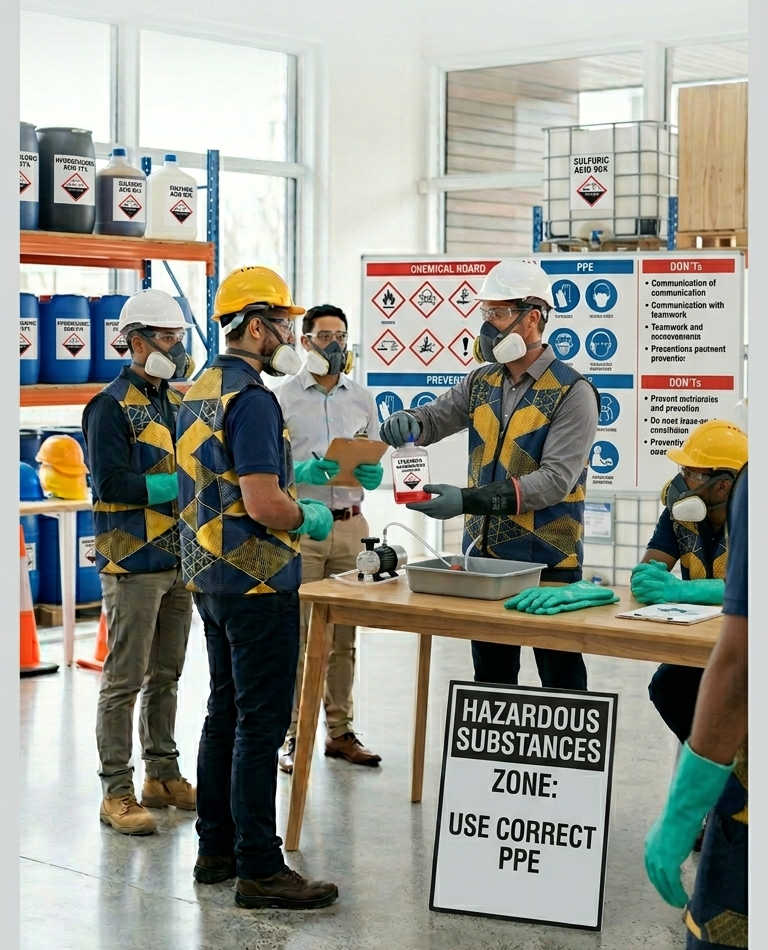
OSHA Compliance and Hazard Communication
OSHA's Hazard Communication Standard (29 CFR 1910.1200) requires employers to have a written hazard communication program, labeled containers, safety data sheets, and employee information and training. The construction standard (29 CFR 1926.59) carries the same requirements. A toolbox talk is a discussion aid and does not replace required training. Double-check all regulations and safety requirements with your employer and OSHA.
How These Talks Support Compliance?
- Employers must give employees information and training on the hazardous chemicals in their work area at the time of initial assignment and whenever a new chemical hazard is introduced (29 CFR 1910.1200(h)(1)).
- Training must cover the employer’s hazard communication program, including labels, the workplace labeling system, and safety data sheets (29 CFR 1910.1200(h)(3)(iv)).
- A sign-in sheet records who attended a talk. It does not certify training or replace required training.
Key OSHA Standards Referenced
- 29 CFR 1910.1200 Hazard Communication Standard (construction: 29 CFR 1926.59)
- Labels (paragraph (f)) and safety data sheets (paragraph (g))
- Employee information and training (paragraph (h))
Additional OSHA Training Resources on Hazard Communication
Download Free Hazard Communication and GHS Toolbox Talks
Download the overview PDF for a list of hazard communication topics and an attendance sign-in sheet for toolbox talks and workplace meetings. Individual talks are not posted separately yet. The PDF is a discussion aid and does not replace employer training or OSHA requirements.
Frequently Asked Questions About Hazard Communication and GHS
Get clear answers about toolbox talks, safety topics, and training resources.
A hazard communication toolbox talk is a short safety meeting about chemical hazards and how container labels, safety data sheets (SDS), and training help protect workers. See OSHA Hazard Communication for details.
Yes. OSHA requires employers to give employees effective information and training on hazardous chemicals in their work area at the time of their initial assignment, and whenever a new chemical hazard they have not been trained about is introduced (29 CFR 1910.1200(h)(1)). A toolbox talk is a discussion aid and does not replace required training.
How often to hold a talk is up to your employer. The standard requires training at initial assignment and when a new chemical hazard is introduced into the work area (29 CFR 1910.1200(h)(1)). A short talk can refresh a topic when new chemicals arrive on the job.
Choose someone who knows your workplace’s chemicals and your employer’s hazard communication program. Review the material and the SDS for the chemicals your crew uses before the talk, so you can explain how the topic applies to the crew’s tasks.
Yes. The overview PDF is free to download and print. It lists the topics in this section and includes a sign-in sheet, which records attendance only.