
Personal Protective Equipment Toolbox Talk Training and PPE Safety Meeting Topics
Download the one-page PPE crew discussion (PDF). A practical discussion aid, separate from the original overview and attendance sheet.
5-minute PPE toolbox talk: check protection before work
Start with the task, not a generic shopping list. Ask which hazards remain after the work’s other controls are in place, and what protection the employer has selected for this task. A hard hat, gloves or safety glasses do not make every task safe, and one item does not protect against every hazard.
Match the protection to the hazard and the worker
Review the employer’s selection and the manufacturer’s instructions. Confirm which PPE is needed, when it must be worn, how it should fit and what it does not protect against. Check the combination of items, rather than assuming that equipment chosen separately will work well together. If the task, exposure or equipment changes, stop and ask the supervisor to review the selection before continuing.
Check condition and fit before use
Look for damage, contamination, missing parts or other conditions that the manufacturer’s instructions identify as reasons not to use the equipment. Do not use defective or damaged PPE. Report the problem and obtain suitable replacement equipment before work that needs that protection. Do not make an improvised modification to get equipment to fit.
Ask for a demonstration, not only a signature
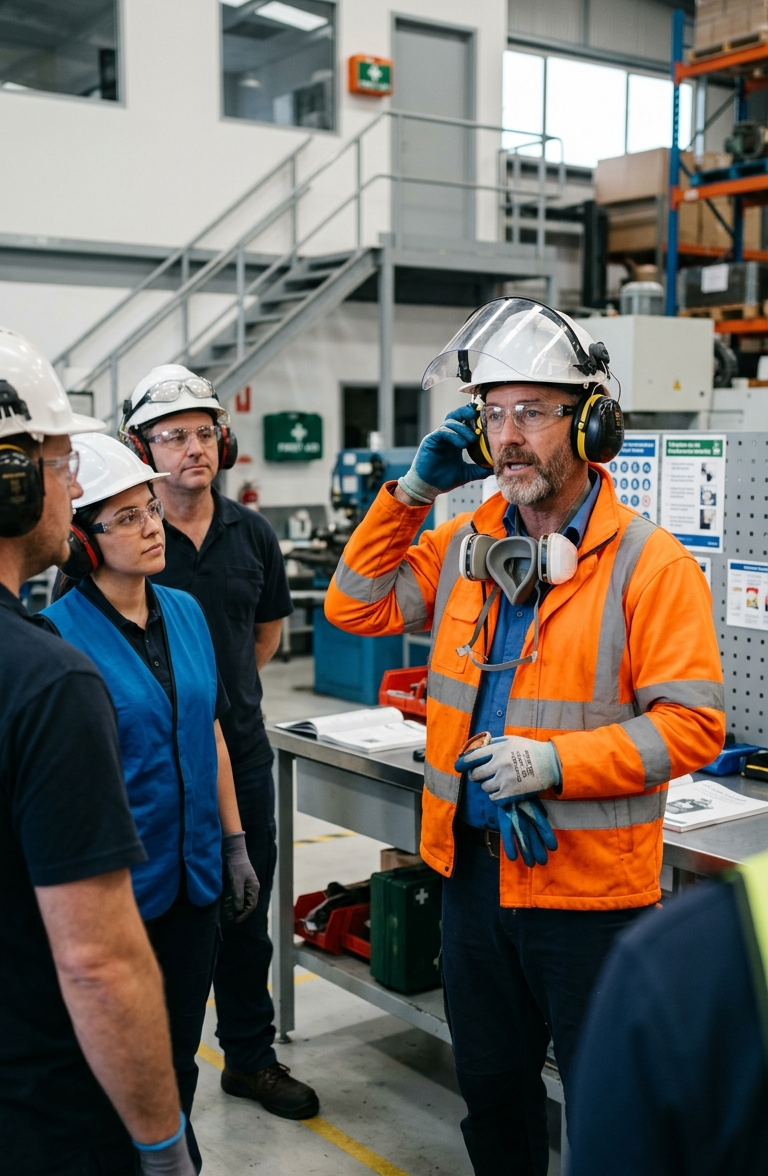
Have the worker show how to put on, adjust, wear and remove the selected PPE, following the employer’s procedure. Ask them to explain its limitations, how to care for and store it, and when it must be replaced or discarded. Under general-industry OSHA 1910.132(f), affected employees must demonstrate understanding and proper use before being allowed to do work requiring the covered PPE. A short discussion or attendance sheet alone does not establish that requirement has been met.
Ask the crew
- What hazard is each selected item protecting us from today?
- Does it fit properly, and does it work with the other equipment we must wear?
- What damage or contamination means we must stop using it?
- Where do we get a replacement, and who reviews a change in the task or exposure?
Close the discussion: record the task, selected protection, any fit or condition problem and the action needed before work. If a worker cannot explain or demonstrate proper use, get the required instruction and practice before proceeding.
Scope matters: OSHA 1910.132(d) and (f) cover specified general-industry PPE rules; they do not replace the separate respiratory-protection or electrical-protective-equipment requirements. Construction work has its own PPE rules, including 1926.95. This discussion is not a respirator program, fit test, electrical-protection procedure or fall-protection training course.
General safety information only. Verify current requirements, employer procedures and manufacturer instructions. This discussion does not replace required training, a workplace hazard assessment or professional safety advice. Reviewed November 3, 2026.
Sources: OSHA 1910.132, general-industry PPE requirements; OSHA 1926.95, construction PPE criteria.
Existing topic descriptions
PPE Hazard Assessment Toolbox Talk | How to Identify Workplace Hazards Before Choosing Safety Gear
General industry employers must assess the workplace to determine whether hazards that require PPE are present or likely to be present. If they are, the employer must select PPE that protects each affected employee, have employees use it, communicate the selection decisions, and select PPE that properly fits each affected employee. The employer must verify the assessment with a written certification that names the workplace evaluated, the person certifying it, the date or dates of the assessment, and identifies the document as a certification of hazard assessment (29 CFR 1910.132(d)). Construction employers must ensure PPE is provided, used, of safe design, and selected to fit each affected employee (1926.95(a), (c); 1926.28).
Eye Protection Toolbox Talk | Prevent Workplace Eye Injuries with the Right PPE
Employers must ensure each affected employee uses appropriate eye or face protection when exposed to hazards from flying particles, molten metal, liquid chemicals, acids or caustic liquids, chemical gases or vapors, or potentially injurious light radiation. Eye protection must provide side protection when there is a hazard from flying objects, and employees who wear prescription lenses must wear protection that incorporates the prescription or fits over their glasses without disturbing the lenses (29 CFR 1910.133(a); 1926.102(a)). Protective devices must meet one of the ANSI Z87.1 editions listed in the rule or be shown to be at least as effective (1910.133(b); 1926.102(b)).
Chemical-Resistant Hand Protection Toolbox Talk | Choosing the Right Gloves for Hazardous Materials
Employers must select and require employees to use appropriate hand protection when their hands are exposed to hazards such as skin absorption of harmful substances, severe cuts or lacerations, severe abrasions, punctures, chemical burns, thermal burns, and harmful temperature extremes. The selection must be based on an evaluation of the performance characteristics of the hand protection relative to the task, the conditions present, the duration of use, and the hazards identified (29 CFR 1910.138). For chemicals, check the safety data sheet and the glove manufacturer’s chemical resistance information, because one glove material does not protect against every chemical.
Cut-Resistant Hand Protection Toolbox Talk | Prevent Cuts, Scrapes, and Hand Injuries at Work
Employers must select and require employees to use appropriate hand protection when their hands are exposed to hazards such as severe cuts or lacerations, severe abrasions, and punctures (29 CFR 1910.138(a)). The selection must be based on the performance characteristics of the glove relative to the task, the conditions present, the duration of use, and the hazards identified (1910.138(b)). A glove that protects against cuts may not protect against chemicals, heat, or punctures, so match the glove to each hazard on the job. Construction employers must ensure PPE is provided, used, and of safe design for the work (1926.95(a), (c)).
Face Protection Toolbox Talk | Prevent Facial Injuries from Flying Debris, Chemicals, and Sparks
Employers must ensure each affected employee uses appropriate eye or face protection when exposed to hazards from flying particles, molten metal, liquid chemicals, acids or caustic liquids, chemical gases or vapors, or potentially injurious light radiation (29 CFR 1910.133(a)(1); 1926.102(a)(1)). Where there is a hazard from flying objects, eye protection must provide side protection ((a)(2)). In general industry, filter lenses must have a shade number appropriate for the work being performed (1910.133(a)(5)). For construction, 1926.102(c) provides Table E-1 as a guide for selecting filter lens shade numbers.
Foot Protection Toolbox Talk | Choosing the Right Safety Footwear for Every Job
Employers must ensure each affected employee uses protective footwear when working in areas where there is a danger of foot injuries from falling or rolling objects or objects piercing the sole, or when footwear will protect against an electrical hazard, such as static discharge or electric shock, that remains after other necessary protective measures (29 CFR 1910.136(a)). Protective footwear must comply with ASTM F-2413-2005 or one of the ANSI Z41 versions listed in the rule, or be shown to be at least as effective (1910.136(b)). In construction, safety-toe footwear must meet the specifications in ANSI Z41.1-1967 (1926.96).
Head Protection Toolbox Talk | Protecting Workers from Falling and Impact Hazards
In construction, employees working where there is a possible danger of head injury from impact, falling or flying objects, or electrical shock and burns must be protected by protective helmets (29 CFR 1926.100(a)). In general industry, a protective helmet must be worn where there is a potential for head injury from falling objects, and a helmet designed to reduce electrical shock hazard must be worn near exposed electrical conductors that could contact the head (1910.135(a)). Head protection must meet one of the ANSI Z89.1 editions listed in the rule or be shown to be at least as effective (1926.100(b); 1910.135(b)).
Hard Hat Safety Toolbox Talk | Best Practices, Common Mistakes, and Proper Care
Defective or damaged personal protective equipment must not be used (29 CFR 1910.132(e)). Employees who must use PPE must be trained in how to properly don, doff, adjust, and wear it, its limitations, and its proper care, maintenance, useful life, and disposal (1910.132(f)(1)). OSHA’s head protection rules (1926.100; 1910.135) do not set a replacement schedule for hard hats. Following the manufacturer’s instructions on inspection, fit adjustment, storage, replacement, and what to do after an impact is good practice, not an OSHA requirement.
Dust Mask Safety Toolbox Talk | Proper Respiratory Protection for Dust and Airborne Particles
A dust mask is a filtering facepiece respirator. Where respirators are not required but an employee asks to use one, the employer may permit voluntary use if the respirator will not itself create a hazard, and must give those employees the information in Appendix D of the respiratory protection standard. Employees whose only respirator use is voluntary use of filtering facepieces (dust masks) need not be included in a written respiratory protection program (29 CFR 1910.134(c)(2)). Where respirator use is required to protect employees, the full standard applies, including selection of a NIOSH-certified respirator and fit testing for tight-fitting facepieces (1910.134(d)(1)(ii), (f)). Construction work follows the same standard (1926.103).
Personal protective equipment is the last layer of protection. It is used together with the hazard controls and training that OSHA and your employer require. This directory summarizes the PPE rules that apply. The overview PDF lists the topics in this section and includes a sign-in sheet.
Workplace Safety Toolbox Talk Personal Protective Equipment Training and Meeting Topics
PPE Hazard Assessment Toolbox Talk | How to Identify Workplace Hazards Before Choosing Safety Gear
General industry employers must assess the workplace to determine whether hazards that require PPE are present or likely to be present. If they are, the employer must select PPE that protects each affected employee, have employees use it, communicate the selection decisions, and select PPE that properly fits each affected employee. The employer must verify the assessment with a written certification that names the workplace evaluated, the person certifying it, the date or dates of the assessment, and identifies the document as a certification of hazard assessment (29 CFR 1910.132(d)). Construction employers must ensure PPE is provided, used, of safe design, and selected to fit each affected employee (1926.95(a), (c); 1926.28).
Eye Protection Toolbox Talk | Prevent Workplace Eye Injuries with the Right PPE
Employers must ensure each affected employee uses appropriate eye or face protection when exposed to hazards from flying particles, molten metal, liquid chemicals, acids or caustic liquids, chemical gases or vapors, or potentially injurious light radiation. Eye protection must provide side protection when there is a hazard from flying objects, and employees who wear prescription lenses must wear protection that incorporates the prescription or fits over their glasses without disturbing the lenses (29 CFR 1910.133(a); 1926.102(a)). Protective devices must meet one of the ANSI Z87.1 editions listed in the rule or be shown to be at least as effective (1910.133(b); 1926.102(b)).
Chemical-Resistant Hand Protection Toolbox Talk | Choosing the Right Gloves for Hazardous Materials
Employers must select and require employees to use appropriate hand protection when their hands are exposed to hazards such as skin absorption of harmful substances, severe cuts or lacerations, severe abrasions, punctures, chemical burns, thermal burns, and harmful temperature extremes. The selection must be based on an evaluation of the performance characteristics of the hand protection relative to the task, the conditions present, the duration of use, and the hazards identified (29 CFR 1910.138). For chemicals, check the safety data sheet and the glove manufacturer's chemical resistance information, because one glove material does not protect against every chemical.
Cut-Resistant Hand Protection Toolbox Talk | Prevent Cuts, Scrapes, and Hand Injuries at Work
Employers must select and require employees to use appropriate hand protection when their hands are exposed to hazards such as severe cuts or lacerations, severe abrasions, and punctures (29 CFR 1910.138(a)). The selection must be based on the performance characteristics of the glove relative to the task, the conditions present, the duration of use, and the hazards identified (1910.138(b)). A glove that protects against cuts may not protect against chemicals, heat, or punctures, so match the glove to each hazard on the job. Construction employers must ensure PPE is provided, used, and of safe design for the work (1926.95(a), (c)).
Face Protection Toolbox Talk | Prevent Facial Injuries from Flying Debris, Chemicals, and Sparks
Employers must ensure each affected employee uses appropriate eye or face protection when exposed to hazards from flying particles, molten metal, liquid chemicals, acids or caustic liquids, chemical gases or vapors, or potentially injurious light radiation (29 CFR 1910.133(a)(1); 1926.102(a)(1)). Where there is a hazard from flying objects, eye protection must provide side protection ((a)(2)). In general industry, filter lenses must have a shade number appropriate for the work being performed (1910.133(a)(5)). For construction, 1926.102(c) provides Table E-1 as a guide for selecting filter lens shade numbers.
Foot Protection Toolbox Talk | Choosing the Right Safety Footwear for Every Job
Employers must ensure each affected employee uses protective footwear when working in areas where there is a danger of foot injuries from falling or rolling objects or objects piercing the sole, or when footwear will protect against an electrical hazard, such as static discharge or electric shock, that remains after other necessary protective measures (29 CFR 1910.136(a)). Protective footwear must comply with ASTM F-2413-2005 or one of the ANSI Z41 versions listed in the rule, or be shown to be at least as effective (1910.136(b)). In construction, safety-toe footwear must meet the specifications in ANSI Z41.1-1967 (1926.96).
Head Protection Toolbox Talk | Protecting Workers from Falling and Impact Hazards
In construction, employees working where there is a possible danger of head injury from impact, falling or flying objects, or electrical shock and burns must be protected by protective helmets (29 CFR 1926.100(a)). In general industry, a protective helmet must be worn where there is a potential for head injury from falling objects, and a helmet designed to reduce electrical shock hazard must be worn near exposed electrical conductors that could contact the head (1910.135(a)). Head protection must meet one of the ANSI Z89.1 editions listed in the rule or be shown to be at least as effective (1926.100(b); 1910.135(b)).
Hard Hat Safety Toolbox Talk | Best Practices, Common Mistakes, and Proper Care
Defective or damaged personal protective equipment must not be used (29 CFR 1910.132(e)). Employees who must use PPE must be trained in how to properly don, doff, adjust, and wear it, its limitations, and its proper care, maintenance, useful life, and disposal (1910.132(f)(1)). OSHA's head protection rules (1926.100; 1910.135) do not set a replacement schedule for hard hats. Following the manufacturer's instructions on inspection, fit adjustment, storage, replacement, and what to do after an impact is good practice, not an OSHA requirement.
Dust Mask Safety Toolbox Talk | Proper Respiratory Protection for Dust and Airborne Particles
A dust mask is a filtering facepiece respirator. Where respirators are not required but an employee asks to use one, the employer may permit voluntary use if the respirator will not itself create a hazard, and must give those employees the information in Appendix D of the respiratory protection standard. Employees whose only respirator use is voluntary use of filtering facepieces (dust masks) need not be included in a written respiratory protection program (29 CFR 1910.134(c)(2)). Where respirator use is required to protect employees, the full standard applies, including selection of a NIOSH-certified respirator and fit testing for tight-fitting facepieces (1910.134(d)(1)(ii), (f)). Construction work follows the same standard (1926.103).
Get Protective Equipment Toolbox Talk Resources
ToolboxTalk.com provides free PPE resources covering common workplace hazards and safe work practices. If your company provides safety equipment, services or training, explore partnership opportunities with ToolboxTalk.
Best Practices for Using Personal Protective Equipment Every Day
Wearing PPE only protects workers when it is part of the daily routine. These practices help keep PPE reliable and in use.
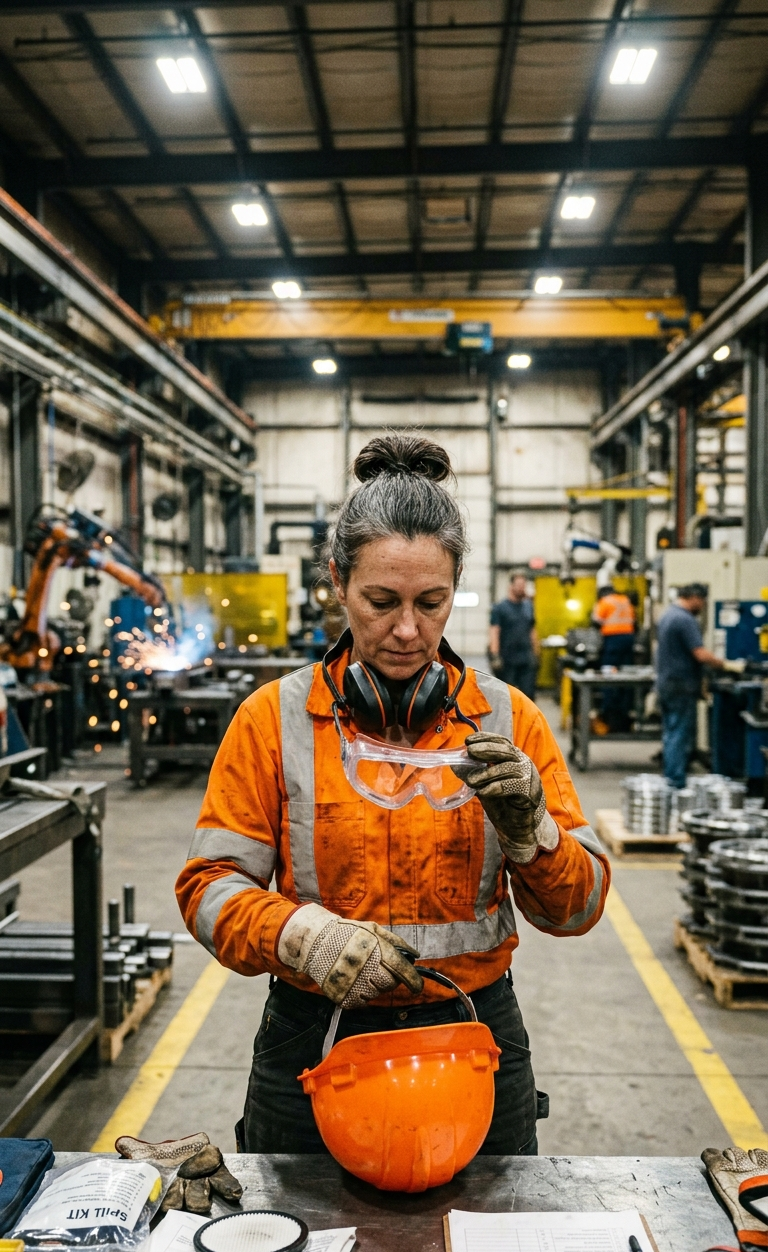
- Inspect PPE before each use for cracks, tears, worn straps, damaged lenses, loose components, or contamination. Defective or damaged PPE must not be used (29 CFR 1910.132(e)).
- Use PPE that matches the job hazard. The employer selects PPE based on the hazards identified and communicates the selection to affected employees (1910.132(d)).
- Wear PPE correctly. PPE must fit each affected employee, and employees must be trained to don, doff, adjust, and wear it (1910.132(d)(1)(iii), (f)(1); 1926.95(c)(2)).
- Keep PPE clean and properly stored. PPE must be maintained in a sanitary and reliable condition (1910.132(a); 1926.95(a)).
- Report damaged or missing PPE immediately so it can be replaced before work continues. Employers generally must pay for replacement PPE unless the employee lost it or intentionally damaged it (1910.132(h)(5); 1926.95(d)(5)).
Trusted Resources to Improve PPE Knowledge and Workplace Safety
Providing PPE is only one part of a safer workplace. A PPE program includes a hazard assessment, training, and keeping equipment in reliable condition.
- Reassess hazards as job tasks, equipment, or work environments change. General industry employers must assess the workplace for hazards that need PPE and certify the assessment in writing (29 CFR 1910.132(d)). The National Institute for Occupational Safety and Health (NIOSH) shares guidance on workplace hazards and protective equipment: NIOSH
- Encourage employees to report damaged PPE, near misses, and unsafe conditions as soon as they are identified.
- Train and retrain. Employees who must use PPE must be trained before use and must show they understand the training. Retraining is required when changes in the workplace or in the PPE make earlier training obsolete, or when an employee’s knowledge or use shows a gap (1910.132(f)). The National Safety Council (NSC) publishes workplace safety education resources.
- Keep records. The written hazard assessment certification is required in general industry (1910.132(d)(2)). Records of PPE inspections, training, and replacement help track problems over time.
- The Center for Construction Research and Training (CPWR) shares research and educational resources on construction safety.

Download Your Free Personal Protective Equipment (PPE) Toolbox Talk PDF
Download the printable Personal Protective Equipment overview. It lists the topics in this section and includes a sign-in sheet that records attendance only. It is a discussion aid and does not replace PPE training, a hazard assessment, or the requirements that OSHA and your employer set.
Frequently Asked Questions About Personal Protective Equipment and PPE Safety Meeting Topics
A PPE toolbox talk is a short safety meeting that reviews how to select, inspect, wear, maintain, and replace PPE. It helps workers recognize job-specific hazards and reinforces safe work practices. A toolbox talk does not replace the PPE training that OSHA requires for employees who must use PPE (29 CFR 1910.132(f)).
A PPE safety meeting can cover the hazards on the job and the PPE needed for each task. OSHA requires employees who must use PPE to be trained on when PPE is necessary, what PPE is necessary, how to properly don, doff, adjust, and wear it, its limitations, and its proper care, maintenance, useful life, and disposal (29 CFR 1910.132(f)(1)). Examples and hands-on demonstrations help workers see how PPE works.
OSHA does not set a schedule for toolbox talks. Under 29 CFR 1910.132(f), employees who must use PPE must be trained before they do the work and must show they understand the training and can use the PPE properly. Retraining is required when changes in the workplace or in the types of PPE make earlier training obsolete, or when an employee’s knowledge or use of PPE shows that the training was not retained (1910.132(f)(2)-(3)).
Defective or damaged PPE must not be used (29 CFR 1910.132(e)). Checking PPE before use helps find damaged, worn, or contaminated equipment before it fails. Workers can check items such as hard hats, safety glasses, gloves, hearing protection, respirators, and protective footwear for cracks, tears, wear, or damage, and follow the manufacturer’s instructions for replacement.
Open the overview PDF in this section. It lists the topics and includes a sign-in sheet that records attendance only. Individual talks are not posted separately.