
Free Scaffold Safety Toolbox Talks and Workplace Fall Prevention Training PDFs
Existing topic descriptions
Basic Scaffold Safety – Competent Person Requirements for Scaffolding
A competent person is someone who can identify existing and predictable hazards and has the authority to take prompt corrective action. A competent person must inspect scaffolds and scaffold components for visible defects before each work shift and after any occurrence that could affect structural integrity (29 CFR 1926.451(f)(3)). Scaffolds must be erected, moved, dismantled, or altered only under the supervision and direction of a competent person (29 CFR 1926.451(f)(7)).
Basic Scaffold Safety – Identifying Different Types of Scaffolds
A scaffold is a temporary elevated platform and its supporting structure. Supported scaffolds rest on rigid supports such as frames, poles, or brackets. Suspension scaffolds hang from an overhead structure by ropes or other non-rigid means. A mobile scaffold is a wheeled supported scaffold. Each type has its own requirements, so confirm the type before you use it (29 CFR 1926.450(b); 1926.452).
Basic Scaffold Safety – Safety Begins at Ground Level
Supported scaffold legs, posts, frames, and uprights must bear on base plates and mud sills or another adequate firm foundation. Footings must be level, sound, rigid, and able to carry the loaded scaffold without settling or displacement. Unstable objects such as barrels, boxes, loose brick, or concrete blocks must not be used to support a scaffold or platform (29 CFR 1926.451(c)(2); 1926.450(b)).
Basic Scaffold Safety – Do’s and Don’ts for Accessing Scaffolding
When a scaffold platform is more than 2 feet above or below the point of access, use a portable, hook-on, or attachable ladder, stair tower, stairway-type ladder, ramp, walkway, or integral prefabricated access. Cross braces must not be used as a means of access (29 CFR 1926.451(e)(1)). A portable ladder used for access must also meet the applicable ladder rules (29 CFR 1926 Subpart X, e.g., 1926.1053, for construction; 1910.23 for general industry).
Basic Scaffold Safety – Fall Protection Requirements for Scaffolding
Fall protection – guardrail systems and/or personal fall arrest systems, with the specific combination set by the scaffold type – is required for each employee on a scaffold more than 10 feet above a lower level (OSHA 1926.451(g)). Workers should always verify which system is required before starting work. In general industry, 29 CFR 1910.28(b)(12) requires scaffold fall protection under the same Subpart L rules.
Basic Scaffold Safety – Prevention of Falling Objects on Scaffolding
In addition to hard hats, each employee on a scaffold must be provided with protection from falling hand tools, debris, and other small objects, such as toeboards, screens, guardrail systems, debris nets, catch platforms, or canopies (29 CFR 1926.451(h)(1)). Where tools or materials could fall and strike people below, the area below must be barricaded or another protection listed in 1926.451(h)(2) must be used. Debris must not be allowed to accumulate on platforms (1926.451(f)(13)).
Basic Scaffold Safety – Keeping It All Together (pins, clamps, & couplers)
Check that pins, clamps, couplers, and braces are in place and secure. A competent person must inspect scaffolds and components for visible defects before each work shift and after any occurrence that could affect structural integrity (29 CFR 1926.451(f)(3)). A part that is damaged or weakened below the required strength must be immediately repaired or replaced, braced, or removed from service (1926.451(f)(4)).
Basic Scaffold Safety – Work Platform Construction
Each platform on all working levels must be fully planked or decked between the front uprights and the guardrail supports, with limited exceptions such as walkways and erection or dismantling work. The space between platform units, and between the platform and the uprights, may not exceed 1 inch unless a wider space is demonstrably necessary, and then the open space between the platform and the uprights may not exceed 9½ inches (29 CFR 1926.451(b)(1)). Platforms must not deflect more than 1/60 of the span when loaded (1926.451(f)(16)).
Basic Scaffold Safety – Manually Propelled Mobile Scaffolds
When a mobile scaffold is used in one place, lock its casters and wheels with positive wheel and/or wheel-and-swivel locks. Apply the force used to move it as close to the base as practicable and not more than 5 feet above the supporting surface (29 CFR 1926.452(w)(2)-(3)). Employees may ride a mobile scaffold only if every condition in 1926.452(w)(6) is met, and each employee on it must be made aware before it is moved (1926.452(w)(10)). Keep it clear of energized power lines (1926.451(f)(6)).
Basic Scaffold Safety – Safety on Work Platforms
Debris must not accumulate on platforms (29 CFR 1926.451(f)(13)). Do not load a scaffold beyond its maximum intended load or rated capacity (1926.451(f)(1)). Employees must not work on a scaffold covered with snow, ice, or other slippery material except as necessary to remove it (1926.451(f)(8)). Boxes, barrels, and similar makeshift devices must not be used on a platform to raise the working height (1926.451(f)(14)). Ladders may be used on a scaffold to gain height only on large area scaffolds that meet the criteria in 1926.451(f)(15).
Basic Scaffold Safety – Working Safely on Suspended Scaffolding
A suspension scaffold hangs from an overhead structure by ropes or other non-rigid means. Each employee on a single-point or two-point adjustable suspension scaffold more than 10 feet above a lower level must be protected by both a personal fall arrest system and a guardrail system (29 CFR 1926.451(g)(1)(ii)). Vertical lifelines must be independent of the scaffold and must not share an anchorage with the suspension ropes (1926.451(g)(3)(i), (iv)). Employees must be trained to recognize the hazards of the scaffold type they use (1926.454(a)). In general industry, rope descent systems have separate requirements (1910.27(b)).
Scaffolds are used on many construction sites, maintenance projects, and industrial work areas where employees perform tasks at elevated heights. This free Basic Scaffold Safety Toolbox Talk directory helps workers recognize scaffold hazards, follow safe setup practices, improve inspection awareness, and reduce fall risks during daily operations. Each printable scaffold safety PDF is designed for effective workplace safety meetings and crew training discussions.

Scaffold Safety Training and Fall Prevention Topics
Basic Scaffold Safety – Competent Person Requirements for Scaffolding
A competent person is someone who can identify existing and predictable hazards and has the authority to take prompt corrective action. A competent person must inspect scaffolds and scaffold components for visible defects before each work shift and after any occurrence that could affect structural integrity (29 CFR 1926.451(f)(3)). Scaffolds must be erected, moved, dismantled, or altered only under the supervision and direction of a competent person (29 CFR 1926.451(f)(7)).
Basic Scaffold Safety – Identifying Different Types of Scaffolds
A scaffold is a temporary elevated platform and its supporting structure. Supported scaffolds rest on rigid supports such as frames, poles, or brackets. Suspension scaffolds hang from an overhead structure by ropes or other non-rigid means. A mobile scaffold is a wheeled supported scaffold. Each type has its own requirements, so confirm the type before you use it (29 CFR 1926.450(b); 1926.452).
Basic Scaffold Safety – Safety Begins at Ground Level
Supported scaffold legs, posts, frames, and uprights must bear on base plates and mud sills or another adequate firm foundation. Footings must be level, sound, rigid, and able to carry the loaded scaffold without settling or displacement. Unstable objects such as barrels, boxes, loose brick, or concrete blocks must not be used to support a scaffold or platform (29 CFR 1926.451(c)(2); 1926.450(b)).
Basic Scaffold Safety – Do’s and Don’ts for Accessing Scaffolding
When a scaffold platform is more than 2 feet above or below the point of access, use a portable, hook-on, or attachable ladder, stair tower, stairway-type ladder, ramp, walkway, or integral prefabricated access. Cross braces must not be used as a means of access (29 CFR 1926.451(e)(1)). A portable ladder used for access must also meet the applicable ladder rules (29 CFR 1926 Subpart X, e.g., 1926.1053, for construction; 1910.23 for general industry).
Basic Scaffold Safety – Fall Protection Requirements for Scaffolding
Fall protection - guardrail systems and/or personal fall arrest systems, with the specific combination set by the scaffold type - is required for each employee on a scaffold more than 10 feet above a lower level (OSHA 1926.451(g)). Workers should always verify which system is required before starting work. In general industry, 29 CFR 1910.28(b)(12) requires scaffold fall protection under the same Subpart L rules.
Basic Scaffold Safety – Prevention of Falling Objects on Scaffolding
In addition to hard hats, each employee on a scaffold must be provided with protection from falling hand tools, debris, and other small objects, such as toeboards, screens, guardrail systems, debris nets, catch platforms, or canopies (29 CFR 1926.451(h)(1)). Where tools or materials could fall and strike people below, the area below must be barricaded or another protection listed in 1926.451(h)(2) must be used. Debris must not be allowed to accumulate on platforms (1926.451(f)(13)).
Basic Scaffold Safety – Keeping It All Together (pins, clamps, & couplers)
Check that pins, clamps, couplers, and braces are in place and secure. A competent person must inspect scaffolds and components for visible defects before each work shift and after any occurrence that could affect structural integrity (29 CFR 1926.451(f)(3)). A part that is damaged or weakened below the required strength must be immediately repaired or replaced, braced, or removed from service (1926.451(f)(4)).
Basic Scaffold Safety – Work Platform Construction
Each platform on all working levels must be fully planked or decked between the front uprights and the guardrail supports, with limited exceptions such as walkways and erection or dismantling work. The space between platform units, and between the platform and the uprights, may not exceed 1 inch unless a wider space is demonstrably necessary, and then the open space between the platform and the uprights may not exceed 9½ inches (29 CFR 1926.451(b)(1)). Platforms must not deflect more than 1/60 of the span when loaded (1926.451(f)(16)).
Basic Scaffold Safety – Manually Propelled Mobile Scaffolds
When a mobile scaffold is used in one place, lock its casters and wheels with positive wheel and/or wheel-and-swivel locks. Apply the force used to move it as close to the base as practicable and not more than 5 feet above the supporting surface (29 CFR 1926.452(w)(2)-(3)). Employees may ride a mobile scaffold only if every condition in 1926.452(w)(6) is met, and each employee on it must be made aware before it is moved (1926.452(w)(10)). Keep it clear of energized power lines (1926.451(f)(6)).
Basic Scaffold Safety – Safety on Work Platforms
Debris must not accumulate on platforms (29 CFR 1926.451(f)(13)). Do not load a scaffold beyond its maximum intended load or rated capacity (1926.451(f)(1)). Employees must not work on a scaffold covered with snow, ice, or other slippery material except as necessary to remove it (1926.451(f)(8)). Boxes, barrels, and similar makeshift devices must not be used on a platform to raise the working height (1926.451(f)(14)). Ladders may be used on a scaffold to gain height only on large area scaffolds that meet the criteria in 1926.451(f)(15).
Basic Scaffold Safety – Working Safely on Suspended Scaffolding
A suspension scaffold hangs from an overhead structure by ropes or other non-rigid means. Each employee on a single-point or two-point adjustable suspension scaffold more than 10 feet above a lower level must be protected by both a personal fall arrest system and a guardrail system (29 CFR 1926.451(g)(1)(ii)). Vertical lifelines must be independent of the scaffold and must not share an anchorage with the suspension ropes (1926.451(g)(3)(i), (iv)). Employees must be trained to recognize the hazards of the scaffold type they use (1926.454(a)). In general industry, rope descent systems have separate requirements (1910.27(b)).
Additional Scaffolding Safety Training Resources
Reach Professionals Focused on Safer Work at Height
ToolboxTalk.com provides practical scaffold safety resources for workers, supervisors and safety teams. If your company supports construction, access equipment or workplace safety, explore partnership opportunities with ToolboxTalk.
Why Scaffolding Safety Matters
Scaffolds are temporary elevated platforms, so the main hazards are falls from the platform, a platform or its support giving way, being struck by falling tools or materials, tipping or collapse, and electrical contact. Hazards like these can be created by:
- Missing or incomplete guardrails
- Improper access to platforms
- Poor scaffold assembly or loose components
- Skipping the inspection before use
- Overloaded or cluttered platforms

Core Principles of Basic Scaffolding Safety
To maintain a safe scaffolding environment, every job site should follow these key principles:
- Set supported scaffold poles, legs, posts, frames, and uprights on base plates and mud sills or other adequate firm foundation, with level, sound, rigid footings (29 CFR 1926.451(c)(2))
- Have a competent person inspect before each work shift and after any occurrence that could affect structural integrity (1926.451(f)(3))
- Do not exceed the maximum intended load or rated capacity (1926.451(f)(1))
- Provide the required fall protection for anyone more than 10 feet above a lower level (1926.451(g))
- Keep platforms free of debris (1926.451(f)(13))
- Protect people from falling tools and materials (1926.451(h))
- Keep scaffolds and conductive materials the required distance from energized power lines (1926.451(f)(6))
- Train employees to recognize the hazards of the scaffold type they use (1926.454)
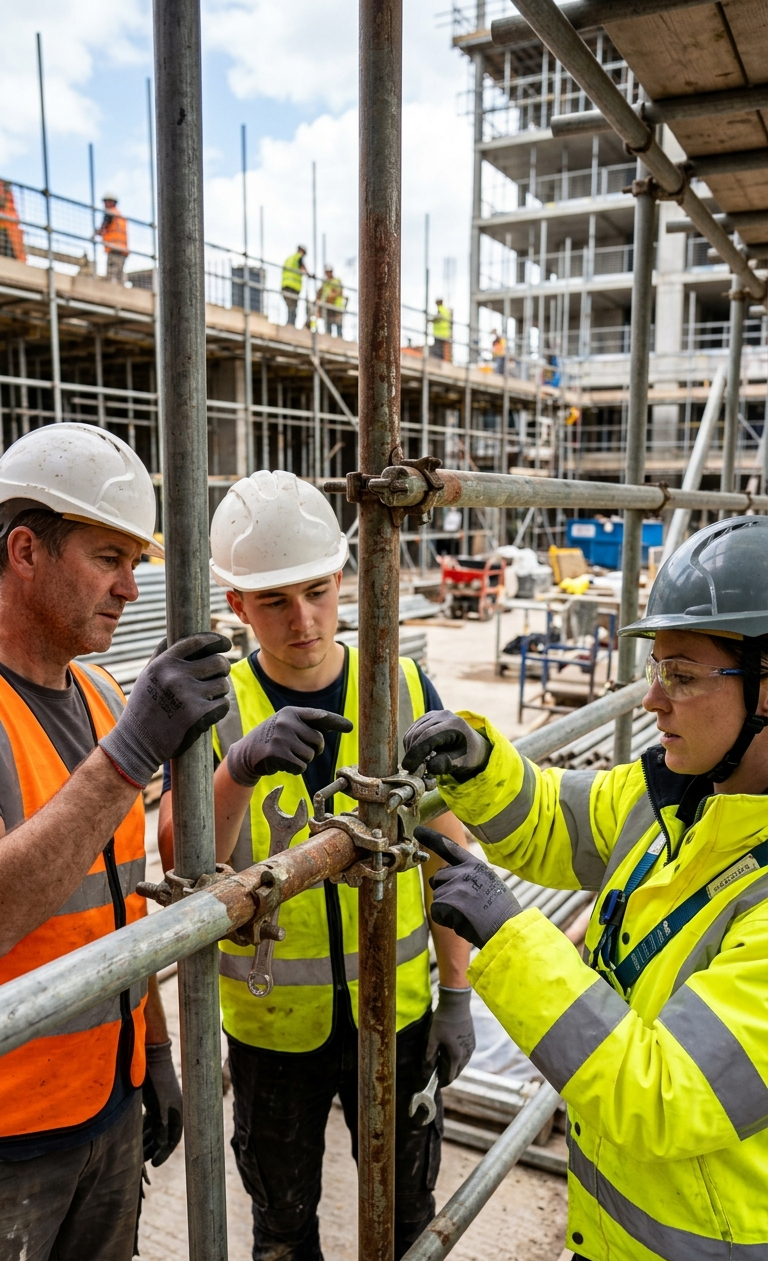
Stay aware. Stay stable. Stay safe on every scaffold.
Scaffolding safety is not just about equipment. It is about daily decisions, awareness, and discipline on site. Using structured scaffolding safety toolbox talks helps build a safer work environment where risks are identified early and controlled effectively.
Get Full Scaffolding Safety Toolbox Talks Pack
Access a set of Basic Scaffolding Safety Toolbox Talks for daily safety meetings, site briefings, and worker training. Each topic is written in simple language. The talks are discussion aids and do not replace the training, inspections, and requirements that OSHA and your employer set for your scaffold.
Frequently Asked Questions (FAQs) Basic Scaffolding Safety Guide
These FAQs are designed to support the Basic Scaffolding Safety Guide and improve understanding of safe scaffold use on real job sites. They cover common risks, best practices, and safety responsibilities using simple, clear language for workers and supervisors.
A basic scaffolding safety guide includes essential rules for safe scaffold setup, inspection, and use. It focuses on preventing falls, ensuring stability, and maintaining safe working platforms.
For the federal requirements, see OSHA’s Scaffolding overview and 29 CFR 1926 Subpart L.
Scaffold safety is managed by a competent person who inspects scaffold conditions and has the authority to take prompt corrective action. Workers also share responsibility by following safety rules and reporting hazards immediately.
Under OSHA’s scaffold standard, a competent person must inspect scaffolds and components for visible defects before each work shift and after any occurrence that could affect structural integrity (29 CFR 1926.451(f)(3)). Scaffolds must be erected, moved, dismantled, or altered only under the supervision and direction of a competent person qualified in those activities (29 CFR 1926.451(f)(7)).
Common hazards include falls from height, unstable platforms, falling tools, and contact with overhead power lines. Poor assembly or missing components can also create serious risks.
In a Bureau of Labor Statistics study of scaffold accidents reviewed by OSHA in support of its 1986 scaffold-standard proposal, 72% of workers injured in scaffold accidents attributed the accident to planking or support giving way, slipping, or being struck by a falling object, and about 25% had received no training in installing, assembling, or inspecting scaffolds.
Each employee on a scaffold more than 10 feet above a lower level must be protected from falling (29 CFR 1926.451(g)(1)). The type of protection depends on the scaffold. For example, a personal fall arrest system is required on a boatswains’ chair or ladder jack scaffold, and both a personal fall arrest system and a guardrail system are required on a single-point or two-point adjustable suspension scaffold. Scaffolds not specifically listed in 1926.451(g)(1)(i)-(vi) use personal fall arrest systems or guardrail systems that meet 1926.451(g)(4) (see (g)(1)(vii)); some types, such as crawling boards and self-contained adjustable scaffolds, have their own rules. Ask your competent person or supervisor which applies, and check the system before work begins.
In general industry, 29 CFR 1910.28(b)(12) requires scaffold fall protection under the same Subpart L rules.
Falling objects can be prevented by securing tools, using toeboards, and keeping platforms organized. Workers should never leave loose materials on elevated surfaces.
In addition to hard hats, OSHA requires protection from falling hand tools, debris, and other small objects, such as toeboards, screens, guardrail systems, debris nets, catch platforms, or canopies. Objects too large or heavy to be contained must be placed away from the edge and secured (29 CFR 1926.451(h)(1)). Where objects could fall and strike people below, the area below must be barricaded or another protection in 1926.451(h)(2) must be used.
A scaffold inspection checklist is a structured guide to help check the scaffold before use. It can include base stability, guardrails, connections, and platform conditions.
OSHA requires a competent person to inspect scaffolds and scaffold components for visible defects before each work shift and after any occurrence that could affect structural integrity (29 CFR 1926.451(f)(3)). Damaged or weakened parts must be repaired or replaced, braced, or removed from service (1926.451(f)(4)). A checklist is a tool for that inspection and does not replace it.
Safe scaffolding starts at ground level with level footing, a firm foundation, and strong base support. If the base is weak or uneven, the whole structure can become unsafe.
Supported scaffold legs, posts, frames, and uprights must bear on base plates and mud sills or other adequate firm foundation. Footings must be level, sound, rigid, and capable of supporting the loaded scaffold without settling or displacement, and unstable objects such as barrels, boxes, loose brick, and concrete blocks must not be used to support scaffolds or platforms (29 CFR 1926.451(c)(2); 1926.450(b)).
Keep scaffolds and anything conductive handled on them the required distance from energized power lines and electrical equipment. Identify electrical hazards before setup or movement.
Under 29 CFR 1926.451(f)(6), scaffolds and conductive material handled on them must stay at least 3 feet from insulated lines under 300 volts, 10 feet from insulated lines of 300 volts to 50 kV, and 10 feet from uninsulated lines under 50 kV. Greater distances apply above 50 kV. Closer work is allowed only after the utility or electrical system operator has been notified and has de-energized or relocated the lines or installed protective coverings.
Scaffold safety toolbox talks keep scaffold hazards in front of the crew and give workers a chance to ask questions before they start work.
A toolbox talk does not replace the training OSHA requires. Employees who work on scaffolds must be trained by a qualified person to recognize the hazards of the scaffold type they use, and employees who erect, move, inspect, or maintain scaffolds must be trained by a competent person (29 CFR 1926.454(a)-(b)).