
Free Welding Cutting and Compressed Gas Safety Toolbox Talk Training and Fire Prevention Topics
Existing topic descriptions
Compressed Gas Cylinder Storage Safety Toolbox Talk (Welding & Cutting Safety Training)
Valve protection caps must be in place and secured on cylinders being stored or moved (29 CFR 1926.350(a)(1)). In general industry, caps must be in place hand-tight on cylinders designed to accept them, except when the cylinder is in use or connected for use, and cylinders must be kept away from radiators and other sources of heat (1910.253(b)(2)). Oxygen cylinders in storage must be separated from fuel-gas cylinders or combustible materials (especially oil or grease) by at least 20 feet, or by a noncombustible barrier at least 5 feet high with a fire-resistance rating of at least one-half hour (1926.350(a)(10); 1910.253(b)(4)(iii)). Inside buildings, cylinders must be stored in a well-protected, well-ventilated, dry location at least 20 feet from highly combustible materials such as oil or excelsior (1926.350(a)(11); 1910.253(b)(2)(ii)). Cylinders must be secured upright at all times, except for short periods while being hoisted or carried (1926.350(a)(9)).
Safe Handling and Transport of Gas Cylinders Toolbox Talk (Oxygen & Acetylene Safety)
When cylinders are hoisted, they must be secured on a cradle, slingboard, or pallet, and must not be hoisted or transported by magnets or choker slings. Cylinders must be moved by tilting and rolling them on their bottom edges, and must not be intentionally dropped, struck, or permitted to strike each other violently (29 CFR 1926.350(a)(2)-(3)). When transported by powered vehicles, cylinders must be secured in a vertical position (1926.350(a)(4)). Valve protection caps must not be used for lifting cylinders, and bars must not be used under valves or caps to pry cylinders loose when frozen (1926.350(a)(5)). Unless cylinders are firmly secured on a special carrier, regulators must be removed and valve protection caps put in place before cylinders are moved, and the cylinder valve must be closed whenever cylinders are moved (1926.350(a)(6), (8)). General industry has matching rules in 1910.253(b)(5).
Compressed Gas Cylinder Operation Safety Toolbox Talk (Workplace Welding Safety Guide)
A suitable cylinder truck, chain, or other steadying device must be used to keep cylinders from being knocked over while in use (29 CFR 1926.350(a)(7)). Cylinders must be kept far enough from the welding or cutting operation that sparks, hot slag, or flame will not reach them, or fire-resistant shields must be provided. They must be placed where they cannot become part of an electrical circuit, and fuel gas cylinders must be valve end up while in use (1926.350(b)(1)-(3)). Before a regulator is connected, the valve is opened slightly and closed immediately (cracking), standing to one side of the outlet, and a fuel gas cylinder valve must not be cracked where the gas would reach welding work, sparks, flame, or other possible ignition sources. Valves must be opened slowly, and fuel gas cylinder valves not more than 1 1/2 turns (1926.350(d)(1)-(2)). If a fuel gas cylinder leaks around the valve stem, the valve is closed and the gland nut tightened. If that does not stop it, the cylinder is tagged and removed from the work area, and a leak at a fuse plug or other safety device also requires removal from the work area (1926.350(d)(5)-(6)). General industry rules are in 1910.253(b)(5).
Welding Torch Assembly Safety Toolbox Talk (Oxy-Fuel Cutting Safety Procedures)
Torches in use must be inspected at the beginning of each working shift for leaking shutoff valves, hose couplings, and tip connections, and defective torches must not be used (29 CFR 1926.350(g)(2)). Clogged tip openings must be cleaned with suitable cleaning wires, drills, or other devices designed for the purpose (1926.350(g)(1)). Hose couplings must be of the type that cannot be unlocked or disconnected by a straight pull without rotary motion (1926.350(f)(5)). Fuel gas must not be used through torches or other devices with shutoff valves without a suitable regulator on the cylinder valve or manifold (1926.350(d)(3)). In general industry, only approved apparatus such as torches, regulators, and manifolds may be used (1910.253(a)(3)).
Welding Hose Safety Inspection Toolbox Talk (Prevent Gas Leaks and Fire Hazards)
Fuel gas hose and oxygen hose must be easily distinguishable from each other and must not be interchangeable, and a single hose with more than one gas passage must not be used. When parallel hoses are taped together, not more than 4 inches out of 12 inches may be covered by tape (29 CFR 1926.350(f)(1)-(2)). Hose in use must be inspected at the beginning of each working shift, and defective hose must be removed from service. Hose that has been subject to flashback or shows evidence of severe wear or damage must be tested to twice the normal pressure, and not less than 300 p.s.i. (1926.350(f)(3)-(4)). Boxes for storing gas hose must be ventilated, and hoses and cables must be kept clear of passageways, ladders, and stairs (1926.350(f)(6)-(7)). In general industry, hose showing leaks, burns, worn places, or other defects must be repaired or replaced (1910.253(e)(5)).
Welding Regulator Safety Toolbox Talk (Pressure Control and Equipment Inspection Guide)
Oxygen and fuel gas pressure regulators, including their gauges, must be in proper working order while in use (29 CFR 1926.350(h)). Before a regulator is removed from a cylinder valve, the cylinder valve must be closed and the gas released from the regulator (1926.350(d)(4)). In general industry, regulators may be used only for the gas and pressures for which they are intended, union nuts and connections must be inspected before use for faulty seats that could leak, gauges on oxygen regulators must be marked “USE NO OIL,” and repairs must be made by skilled mechanics who have been properly instructed (1910.253(e)(6)). Cylinders, caps, valves, couplings, regulators, hose, and apparatus must be kept free from oily or greasy substances (1926.350(i)).
Safe Torch Use Toolbox Talk (Welding and Cutting Operation Safety Procedures)
In construction, torches must be lighted by friction lighters or other approved devices, and not by matches or from hot work (29 CFR 1926.350(g)(3)). In construction, to prevent fires in enclosed spaces from gas escaping through leaking or improperly closed torch valves, the gas supply to the torch must be positively shut off at some point outside the enclosed space whenever the torch is not to be used or is left unattended for a substantial period of time, such as the lunch period. Overnight and at the change of shifts, the torch and hose must be removed from the confined space, and open-end fuel gas and oxygen hoses must be removed immediately from enclosed spaces when they are disconnected from the torch or other gas-consuming device (1926.352(g)). In general industry, when gas welding or cutting in a confined space, the torch valves must be closed and the gas supply positively shut off at some point outside the confined area whenever the torch is not to be used for a substantial period of time, such as during lunch hour or overnight, and where practicable the torch and hose must also be removed from the confined space (1910.252(a)(4)(ii)). In construction, oxygen must not be used for ventilation, comfort cooling, blowing dust from clothing, or cleaning the work area (1926.353(a)(6)). Flame adjustment and shutdown steps are manufacturer guidance and are not in these sections.
Electric Arc Welding Safety Toolbox Talk (Electrical Shock and Burn Prevention Training)
In construction, only electrode holders designed for arc welding and cutting, with enough capacity for the maximum current, may be used, and current-carrying parts of the holder and jaw surfaces must be fully insulated (29 CFR 1926.351(a)). Cables must be completely insulated and flexible, and cable with repairs or splices within 10 feet of the electrode holder end may not be used except with standard insulated connectors or equal splices. Cables needing repair must not be used (1926.351(b)). Machine frames must be grounded, ground connections must be inspected, and pipelines containing gases or flammable liquids, or conduits with electrical circuits, must not be used as a ground return (1926.351(c)). Unattended electrode holders must have the electrodes removed and be placed so they cannot make electrical contact, hot holders must not be dipped in water, the power switch must be opened when the welder leaves or the machine is moved, and faulty equipment must be reported to the supervisor (1926.351(d)). In general industry, connections and machine frame grounding must be checked before operating, wet machines must be dried and tested, cables with damaged insulation replaced, and the manufacturer’s printed instructions strictly followed (1910.254(d)).
Hot Work Safety Toolbox Talk (Fire Prevention for Welding and Cutting Operations)
In construction, when normal fire prevention precautions are not enough, additional personnel must be assigned to guard against fire while the work is performed and for a sufficient time afterward to ensure no possibility of fire. They must be instructed on the anticipated fire hazards and how to use the firefighting equipment (29 CFR 1926.352(e)). When practical, the work is moved to a safe location or movable fire hazards are moved or protected, and if the hazards cannot all be removed, heat, sparks, and slag must be confined by positive means (1926.352(a)-(b)). No welding, cutting, or heating may be done where flammable paints, other flammable compounds, or heavy dust concentrations create a hazard, and suitable fire extinguishing equipment must be immediately available (1926.352(c)-(d)). In general industry, fire watchers are required where other than a minor fire might develop, including appreciable combustibles within 35 feet of the point of operation. The area must be inspected before work is authorized by the person responsible, “preferably in the form of a written permit” (1910.252(a)(2)(iii)-(iv)). The rules shown here do not require a written permit in every case.
Welding Radiation Safety Toolbox Talk (UV Exposure and Eye Protection Training)
In general industry, helmets or hand shields must be used during all arc welding or arc cutting except submerged arc welding, helpers and attendants must have proper eye protection, and goggles or other suitable eye protection must be used for gas welding and oxygen cutting (29 CFR 1910.252(b)(2)(i)). In construction, employees performing any type of welding, cutting, or heating must have suitable eye protection that meets Subpart E (1926.353(e)(2)). Arc welding and cutting operations must be shielded whenever practicable by noncombustible or flameproof screens that protect nearby employees from the direct rays of the arc (1926.351(e)). For inert-gas metal-arc welding in construction, employees not protected by screening need filter lenses, exposed skin must be completely covered against ultraviolet burns, and helmets and hand shields must be free of leaks, openings, and highly reflective surfaces (1926.353(d)(1)).
Welding Fume Exposure Safety Toolbox Talk (Respiratory Protection and Air Quality Control)
In construction, welding, cutting, or heating in a confined space requires general mechanical or local exhaust ventilation. If enough ventilation cannot be had without blocking access, employees must be protected by air line respirators and an employee outside must keep communication and help in an emergency (29 CFR 1926.353(b)). Welding, cutting, or heating in enclosed spaces on zinc, lead, cadmium, or chromium metals or coatings requires mechanical ventilation. For lead, cadmium, mercury, or beryllium materials it requires local exhaust or air line respirators, and beryllium requires both (1926.353(c)(1)-(2)). Local exhaust hoods must be placed as close as practicable to the work, and replacement air must be clean and respirable (1926.353(a)). In general industry, local exhaust or general ventilation must keep toxic fumes, gases, and dusts below the limits in 1910.1000, and the hazardous materials in fluxes, coatings, and filler metals must be in the hazard communication program (1910.252(c)(1)).
Welding PPE Safety Toolbox Talk (Protective Clothing and Job Site Safety Standards)
Employees exposed to welding, cutting, or brazing hazards must be protected by personal protective equipment under 29 CFR 1910.132 in general industry, and the protective clothing required varies with the size, nature, and location of the work (1910.252(b)(3)). Eye and face protection requirements are in 1910.252(b)(2) and, for construction, 1926.353(e)(2). In construction, inert-gas metal-arc welding requires exposed skin to be completely covered against ultraviolet burns (1926.353(d)(1)(iii)). The rules shown here do not list specific items such as gloves, aprons, or boots. Choose them from the hazard assessment and the manufacturer’s guidance.
Welding, cutting, and compressed gas work creates fire, electrical, fume, radiation, and cylinder hazards. This directory summarizes OSHA rules for welding and cutting in 29 CFR 1926 Subpart J (construction) and 29 CFR 1910 Subpart Q (general industry), with citations. The overview PDF lists the topics in this section and includes a sign-in sheet that records attendance only.
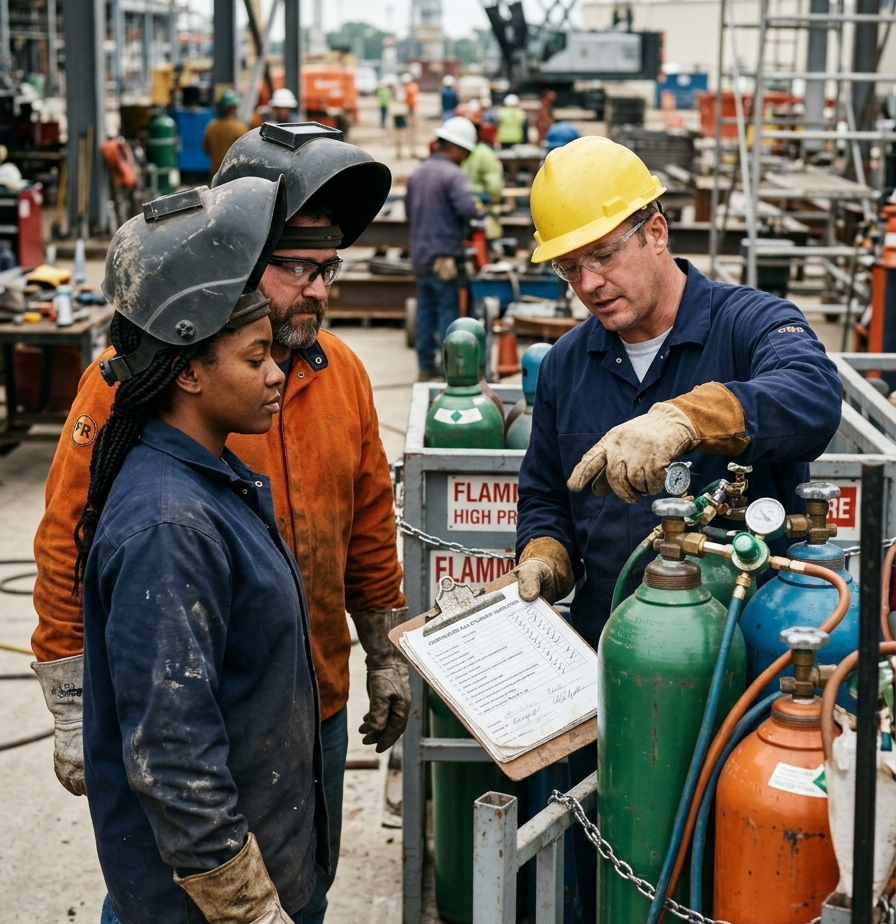
Welding Cutting and Compressed Gas Safety Toolbox Talk Training for Higher Compliance
Compressed Gas Cylinder Storage Safety Toolbox Talk (Welding & Cutting Safety Training)
Valve protection caps must be in place and secured on cylinders being stored or moved (29 CFR 1926.350(a)(1)). In general industry, caps must be in place hand-tight on cylinders designed to accept them, except when the cylinder is in use or connected for use, and cylinders must be kept away from radiators and other sources of heat (1910.253(b)(2)). Oxygen cylinders in storage must be separated from fuel-gas cylinders or combustible materials (especially oil or grease) by at least 20 feet, or by a noncombustible barrier at least 5 feet high with a fire-resistance rating of at least one-half hour (1926.350(a)(10); 1910.253(b)(4)(iii)). Inside buildings, cylinders must be stored in a well-protected, well-ventilated, dry location at least 20 feet from highly combustible materials such as oil or excelsior (1926.350(a)(11); 1910.253(b)(2)(ii)). Cylinders must be secured upright at all times, except for short periods while being hoisted or carried (1926.350(a)(9)).
Safe Handling and Transport of Gas Cylinders Toolbox Talk (Oxygen & Acetylene Safety)
When cylinders are hoisted, they must be secured on a cradle, slingboard, or pallet, and must not be hoisted or transported by magnets or choker slings. Cylinders must be moved by tilting and rolling them on their bottom edges, and must not be intentionally dropped, struck, or permitted to strike each other violently (29 CFR 1926.350(a)(2)-(3)). When transported by powered vehicles, cylinders must be secured in a vertical position (1926.350(a)(4)). Valve protection caps must not be used for lifting cylinders, and bars must not be used under valves or caps to pry cylinders loose when frozen (1926.350(a)(5)). Unless cylinders are firmly secured on a special carrier, regulators must be removed and valve protection caps put in place before cylinders are moved, and the cylinder valve must be closed whenever cylinders are moved (1926.350(a)(6), (8)). General industry has matching rules in 1910.253(b)(5).
Compressed Gas Cylinder Operation Safety Toolbox Talk (Workplace Welding Safety Guide)
A suitable cylinder truck, chain, or other steadying device must be used to keep cylinders from being knocked over while in use (29 CFR 1926.350(a)(7)). Cylinders must be kept far enough from the welding or cutting operation that sparks, hot slag, or flame will not reach them, or fire-resistant shields must be provided. They must be placed where they cannot become part of an electrical circuit, and fuel gas cylinders must be valve end up while in use (1926.350(b)(1)-(3)). Before a regulator is connected, the valve is opened slightly and closed immediately (cracking), standing to one side of the outlet, and a fuel gas cylinder valve must not be cracked where the gas would reach welding work, sparks, flame, or other possible ignition sources. Valves must be opened slowly, and fuel gas cylinder valves not more than 1 1/2 turns (1926.350(d)(1)-(2)). If a fuel gas cylinder leaks around the valve stem, the valve is closed and the gland nut tightened. If that does not stop it, the cylinder is tagged and removed from the work area, and a leak at a fuse plug or other safety device also requires removal from the work area (1926.350(d)(5)-(6)). General industry rules are in 1910.253(b)(5).
Welding Torch Assembly Safety Toolbox Talk (Oxy-Fuel Cutting Safety Procedures)
Torches in use must be inspected at the beginning of each working shift for leaking shutoff valves, hose couplings, and tip connections, and defective torches must not be used (29 CFR 1926.350(g)(2)). Clogged tip openings must be cleaned with suitable cleaning wires, drills, or other devices designed for the purpose (1926.350(g)(1)). Hose couplings must be of the type that cannot be unlocked or disconnected by a straight pull without rotary motion (1926.350(f)(5)). Fuel gas must not be used through torches or other devices with shutoff valves without a suitable regulator on the cylinder valve or manifold (1926.350(d)(3)). In general industry, only approved apparatus such as torches, regulators, and manifolds may be used (1910.253(a)(3)).
Welding Hose Safety Inspection Toolbox Talk (Prevent Gas Leaks and Fire Hazards)
Fuel gas hose and oxygen hose must be easily distinguishable from each other and must not be interchangeable, and a single hose with more than one gas passage must not be used. When parallel hoses are taped together, not more than 4 inches out of 12 inches may be covered by tape (29 CFR 1926.350(f)(1)-(2)). Hose in use must be inspected at the beginning of each working shift, and defective hose must be removed from service. Hose that has been subject to flashback or shows evidence of severe wear or damage must be tested to twice the normal pressure, and not less than 300 p.s.i. (1926.350(f)(3)-(4)). Boxes for storing gas hose must be ventilated, and hoses and cables must be kept clear of passageways, ladders, and stairs (1926.350(f)(6)-(7)). In general industry, hose showing leaks, burns, worn places, or other defects must be repaired or replaced (1910.253(e)(5)).
Welding Regulator Safety Toolbox Talk (Pressure Control and Equipment Inspection Guide)
Oxygen and fuel gas pressure regulators, including their gauges, must be in proper working order while in use (29 CFR 1926.350(h)). Before a regulator is removed from a cylinder valve, the cylinder valve must be closed and the gas released from the regulator (1926.350(d)(4)). In general industry, regulators may be used only for the gas and pressures for which they are intended, union nuts and connections must be inspected before use for faulty seats that could leak, gauges on oxygen regulators must be marked "USE NO OIL," and repairs must be made by skilled mechanics who have been properly instructed (1910.253(e)(6)). Cylinders, caps, valves, couplings, regulators, hose, and apparatus must be kept free from oily or greasy substances (1926.350(i)).
Safe Torch Use Toolbox Talk (Welding and Cutting Operation Safety Procedures)
In construction, torches must be lighted by friction lighters or other approved devices, and not by matches or from hot work (29 CFR 1926.350(g)(3)). In construction, to prevent fires in enclosed spaces from gas escaping through leaking or improperly closed torch valves, the gas supply to the torch must be positively shut off at some point outside the enclosed space whenever the torch is not to be used or is left unattended for a substantial period of time, such as the lunch period. Overnight and at the change of shifts, the torch and hose must be removed from the confined space, and open-end fuel gas and oxygen hoses must be removed immediately from enclosed spaces when they are disconnected from the torch or other gas-consuming device (1926.352(g)). In general industry, when gas welding or cutting in a confined space, the torch valves must be closed and the gas supply positively shut off at some point outside the confined area whenever the torch is not to be used for a substantial period of time, such as during lunch hour or overnight, and where practicable the torch and hose must also be removed from the confined space (1910.252(a)(4)(ii)). In construction, oxygen must not be used for ventilation, comfort cooling, blowing dust from clothing, or cleaning the work area (1926.353(a)(6)). Flame adjustment and shutdown steps are manufacturer guidance and are not in these sections.
Electric Arc Welding Safety Toolbox Talk (Electrical Shock and Burn Prevention Training)
In construction, only electrode holders designed for arc welding and cutting, with enough capacity for the maximum current, may be used, and current-carrying parts of the holder and jaw surfaces must be fully insulated (29 CFR 1926.351(a)). Cables must be completely insulated and flexible, and cable with repairs or splices within 10 feet of the electrode holder end may not be used except with standard insulated connectors or equal splices. Cables needing repair must not be used (1926.351(b)). Machine frames must be grounded, ground connections must be inspected, and pipelines containing gases or flammable liquids, or conduits with electrical circuits, must not be used as a ground return (1926.351(c)). Unattended electrode holders must have the electrodes removed and be placed so they cannot make electrical contact, hot holders must not be dipped in water, the power switch must be opened when the welder leaves or the machine is moved, and faulty equipment must be reported to the supervisor (1926.351(d)). In general industry, connections and machine frame grounding must be checked before operating, wet machines must be dried and tested, cables with damaged insulation replaced, and the manufacturer's printed instructions strictly followed (1910.254(d)).
Hot Work Safety Toolbox Talk (Fire Prevention for Welding and Cutting Operations)
In construction, when normal fire prevention precautions are not enough, additional personnel must be assigned to guard against fire while the work is performed and for a sufficient time afterward to ensure no possibility of fire. They must be instructed on the anticipated fire hazards and how to use the firefighting equipment (29 CFR 1926.352(e)). When practical, the work is moved to a safe location or movable fire hazards are moved or protected, and if the hazards cannot all be removed, heat, sparks, and slag must be confined by positive means (1926.352(a)-(b)). No welding, cutting, or heating may be done where flammable paints, other flammable compounds, or heavy dust concentrations create a hazard, and suitable fire extinguishing equipment must be immediately available (1926.352(c)-(d)). In general industry, fire watchers are required where other than a minor fire might develop, including appreciable combustibles within 35 feet of the point of operation. The area must be inspected before work is authorized by the person responsible, "preferably in the form of a written permit" (1910.252(a)(2)(iii)-(iv)). The rules shown here do not require a written permit in every case.
Welding Radiation Safety Toolbox Talk (UV Exposure and Eye Protection Training)
In general industry, helmets or hand shields must be used during all arc welding or arc cutting except submerged arc welding, helpers and attendants must have proper eye protection, and goggles or other suitable eye protection must be used for gas welding and oxygen cutting (29 CFR 1910.252(b)(2)(i)). In construction, employees performing any type of welding, cutting, or heating must have suitable eye protection that meets Subpart E (1926.353(e)(2)). Arc welding and cutting operations must be shielded whenever practicable by noncombustible or flameproof screens that protect nearby employees from the direct rays of the arc (1926.351(e)). For inert-gas metal-arc welding in construction, employees not protected by screening need filter lenses, exposed skin must be completely covered against ultraviolet burns, and helmets and hand shields must be free of leaks, openings, and highly reflective surfaces (1926.353(d)(1)).
Welding Fume Exposure Safety Toolbox Talk (Respiratory Protection and Air Quality Control)
In construction, welding, cutting, or heating in a confined space requires general mechanical or local exhaust ventilation. If enough ventilation cannot be had without blocking access, employees must be protected by air line respirators and an employee outside must keep communication and help in an emergency (29 CFR 1926.353(b)). Welding, cutting, or heating in enclosed spaces on zinc, lead, cadmium, or chromium metals or coatings requires mechanical ventilation. For lead, cadmium, mercury, or beryllium materials it requires local exhaust or air line respirators, and beryllium requires both (1926.353(c)(1)-(2)). Local exhaust hoods must be placed as close as practicable to the work, and replacement air must be clean and respirable (1926.353(a)). In general industry, local exhaust or general ventilation must keep toxic fumes, gases, and dusts below the limits in 1910.1000, and the hazardous materials in fluxes, coatings, and filler metals must be in the hazard communication program (1910.252(c)(1)).
Welding PPE Safety Toolbox Talk (Protective Clothing and Job Site Safety Standards)
Employees exposed to welding, cutting, or brazing hazards must be protected by personal protective equipment under 29 CFR 1910.132 in general industry, and the protective clothing required varies with the size, nature, and location of the work (1910.252(b)(3)). Eye and face protection requirements are in 1910.252(b)(2) and, for construction, 1926.353(e)(2). In construction, inert-gas metal-arc welding requires exposed skin to be completely covered against ultraviolet burns (1926.353(d)(1)(iii)). The rules shown here do not list specific items such as gloves, aprons, or boots. Choose them from the hazard assessment and the manufacturer's guidance.
Get Free Welding, Cutting and Compressed Gas Safety Resources
ToolboxTalk.com provides free welding safety resources covering common workplace hazards and safe work practices. If your company provides safety equipment, services or training, explore partnership opportunities with ToolboxTalk.
Safe Hot Work Practices for Welding, Cutting & Fire Prevention in the Workplace
- Hot work fire prevention in construction: move the work or the fire hazards, confine heat, sparks, and slag, keep extinguishing equipment immediately available, and assign a fire watch when normal precautions are not enough (29 CFR 1926.352).
- In general industry, a fire watch is required where other than a minor fire might develop, and the area is inspected before work is authorized, preferably with a written permit (1910.252(a)(2)).
- No welding, cutting, or heating where flammable paints, other flammable compounds, or heavy dust concentrations create a hazard (1926.352(c)).
- Containers that held flammable or toxic substances must be cleaned or filled with water, ventilated, and tested before heat is applied, and a vent opening is provided first (1926.352(i)-(j)).
- Your employer’s hot work program may be stricter than these rules, so follow it.
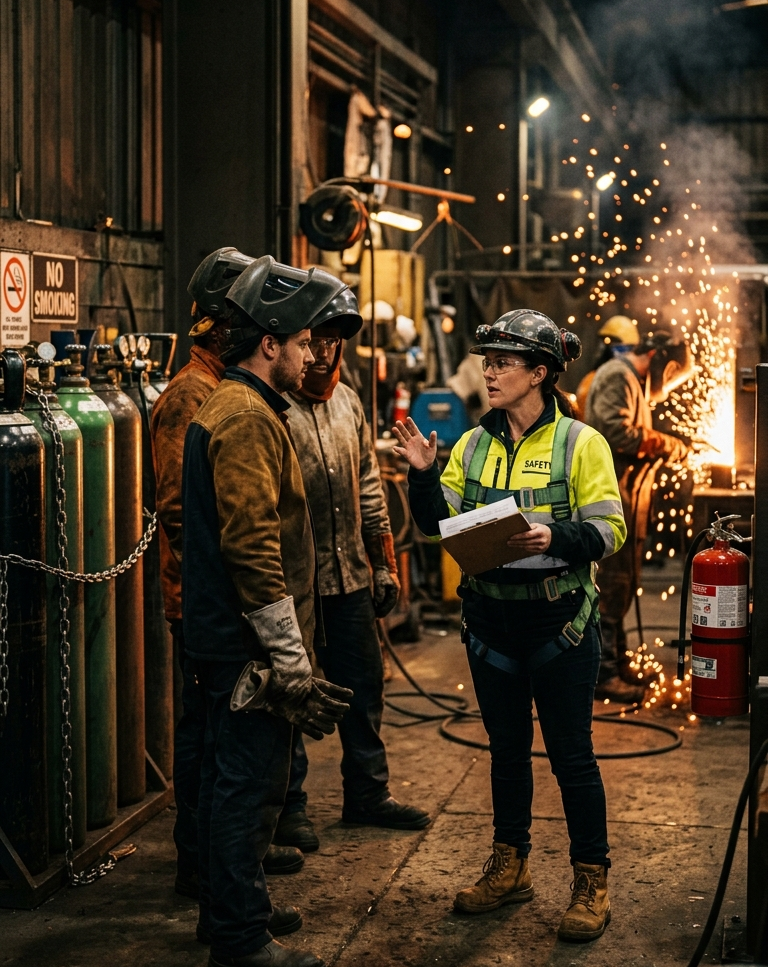
Compressed Gas Cylinder Handling, Storage & Leak Prevention Safety Training
- Move cylinders by tilting and rolling them on their bottom edges, secured upright in vehicles, with valve protection caps in place (29 CFR 1926.350(a)).
- Store oxygen at least 20 feet from fuel-gas cylinders or combustibles, or behind a noncombustible barrier at least 5 feet high (1926.350(a)(10); 1910.253(b)(4)(iii)).
- Keep cylinders upright and secured, with valve protection caps on, away from sparks, heat, and electrical circuits (1926.350(a)-(b)).
- Inspect hose and torches at the start of each shift for leaks and damage, and keep regulators in proper working order (1926.350(f)-(h)).
- Tag and remove leaking fuel gas cylinders from the work area as the rule describes (1926.350(d)(5)-(6)).
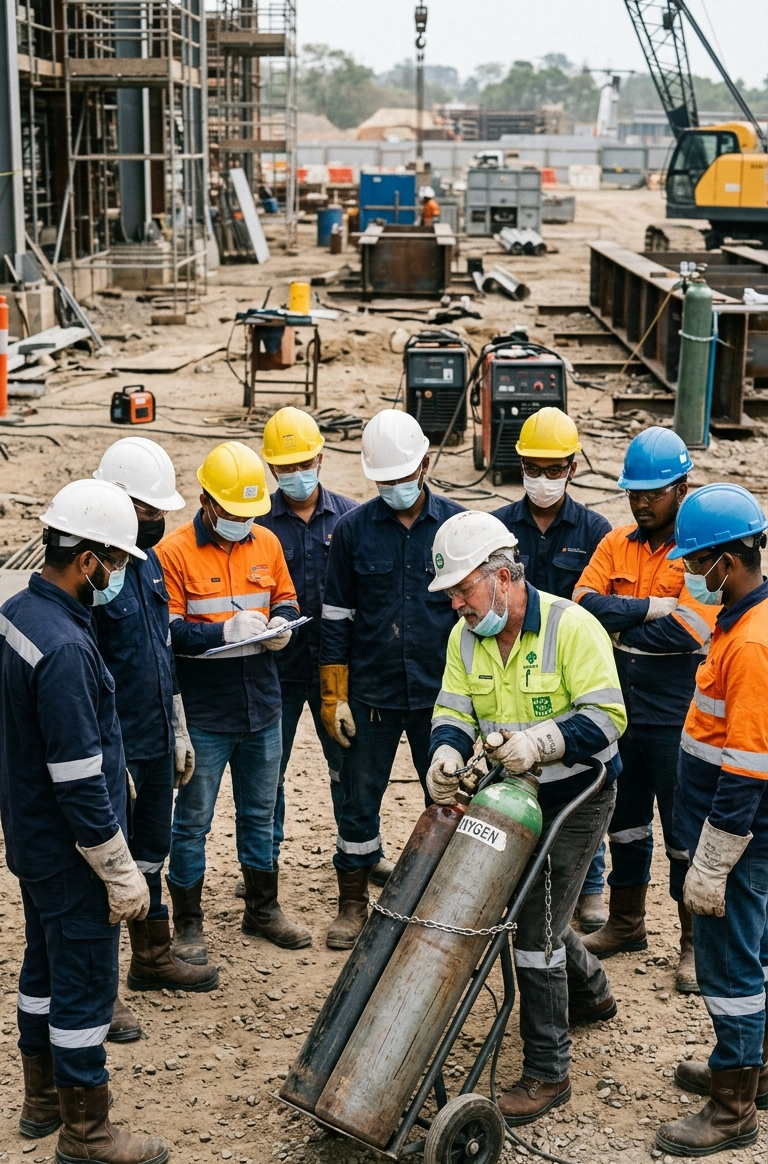
Download the Welding, Cutting and Compressed Gas Safety Overview PDF
Download the printable Welding, Cutting and Compressed Gas Safety overview. It lists the topics in this section and includes a sign-in sheet that records attendance only. It is a discussion aid and does not replace training, equipment inspections, or the requirements that OSHA and your employer set.
Frequently Asked Questions (FAQs) – Welding, Cutting & Compressed Gas Safety Toolbox Talk Training
Get clear answers about toolbox talks, safety topics, and training resources.
A welding, cutting, and compressed gas safety toolbox talk is a short meeting that reviews the hazards of hot work and gas cylinders and the rules that control them: fire prevention, cylinder handling and storage, hose, torch, and regulator condition, arc welding equipment, ventilation, and eye protection (29 CFR 1926 Subpart J; 1910 Subpart Q). A toolbox talk does not replace required training or the manufacturer’s instructions.
Welding and cutting produce sparks, hot slag, and flame that can ignite nearby materials. The rules require moving or protecting fire hazards, confining heat, sparks, and slag, keeping fire extinguishing equipment immediately available, and a fire watch when normal precautions are not enough (29 CFR 1926.352; 1910.252(a)).
The rules on cylinders address storage, securing, valve protection caps, separating oxygen from fuel gas, keeping cylinders away from heat, sparks, and electrical circuits, and removing leaking cylinders from the work area (29 CFR 1926.350; 1910.253(b)).
Anyone who welds, cuts, or helps with that work, or works near it, is affected. Helpers and attendants need proper eye protection in general industry (29 CFR 1910.252(b)(2)(i)), and when welding or cutting on metals of toxic significance in construction, other employees exposed to the same atmosphere must be protected in the same manner as the welder (1926.353(c)(4)).
The overview PDF for this section is on this page. It lists the topics and includes a sign-in sheet that records attendance only. It is not individual talks, and it does not replace training or the requirements set by OSHA and your employer.