
Free Hazardous Substances Awareness Toolbox Talks and Chemical Safety Meeting Topics
Existing topic descriptions
Hazardous Substance Awareness — Introduction (Read First)
The overview introduces the four substance discussions and the need to check the rules for the actual operation. It is not an asbestos-removal, spill-response, or exposure-control procedure.
Hazardous Substance Awareness — Arsenic
Discuss inorganic arsenic hazards, exposure assessment, and regulatory scope. Treated-wood work has specific scope exclusions, but other protections still apply.
Hazardous Substance Awareness — Asbestos
Discuss asbestos health hazards and the employer’s identification, exposure-assessment, control, and training duties before construction work.
Hazardous Substance Awareness — Benzene
Discuss benzene health and flammability hazards, exposure assessment, and protections for covered operations. Not every fuel operation is covered by the benzene standard.
Hazardous Substance Awareness — Beryllium
Discuss beryllium sensitization, chronic beryllium disease, and construction exposure-assessment and control requirements.
Use these resources to discuss arsenic, asbestos, benzene, and beryllium hazards. They are discussion aids, not chemical-specific work procedures, proof of compliance, or a substitute for required training. The employer must identify the chemicals and hazards in the actual work and establish the applicable protections.

Hazardous Substances Awareness Toolbox Talks
Hazardous Substance Awareness — Introduction (Read First)
Start here before conducting individual chemical safety talks. Covers basic hazard recognition, exposure routes, labeling awareness, and employee responsibilities when working around hazardous substances.
Hazardous Substance Awareness — Arsenic
Understand arsenic exposure risks commonly found in industrial processes, treated materials, and contaminated environments. Learn safe handling practices and exposure prevention methods.
Hazardous Substance Awareness — Asbestos
Review asbestos hazards, disturbance risks during renovation or demolition work, and required safety precautions to prevent airborne exposure.
Hazardous Substance Awareness — Benzene
Learn how benzene exposure occurs, recognize health risks, and apply workplace controls to minimize inhalation and skin contact hazards.
Hazardous Substance Awareness — Beryllium
Understand beryllium exposure risks in manufacturing and metal work environments, including respiratory protection and contamination control practices.
Upcoming Releases for 2026
Support Hazardous Substances Safety Resources
ToolboxTalk.com provides free resources for workplace discussions about hazardous substances. If your company provides hazardous-substance safety equipment, services, or training, explore partnership opportunities with ToolboxTalk.
How to Lead Hazardous Substances Safety Meetings?
Use the material as a starting point for a job-specific discussion.
- Have the employer identify the hazardous chemicals and tasks involved.
- Review the relevant labels, Safety Data Sheets, exposure information, and applicable work procedures.
- Discuss the employer’s protective measures, emergency procedures, and required PPE.
- Provide the required information and training for the actual operation. A discussion or attendance signature alone does not establish completion.
- Invite questions and record attendance separately from any assessment of knowledge or competence.

Common Hazardous Substance Exposure Risks
Exposure routes and health effects differ by chemical. For example, NIOSH lists inhalation, skin absorption, ingestion, and skin or eye contact as exposure routes for benzene. Check the product label, Safety Data Sheet, and employer’s exposure assessment rather than assuming every substance has the same hazards.
OSHA’s chemical-hazards guidance says engineering and work-practice controls must be the primary means to reduce exposure to toxic chemicals where feasible. Respiratory protection is required if those controls are infeasible or while engineering controls are being implemented. The applicable standard and the actual operation determine which protections are required.
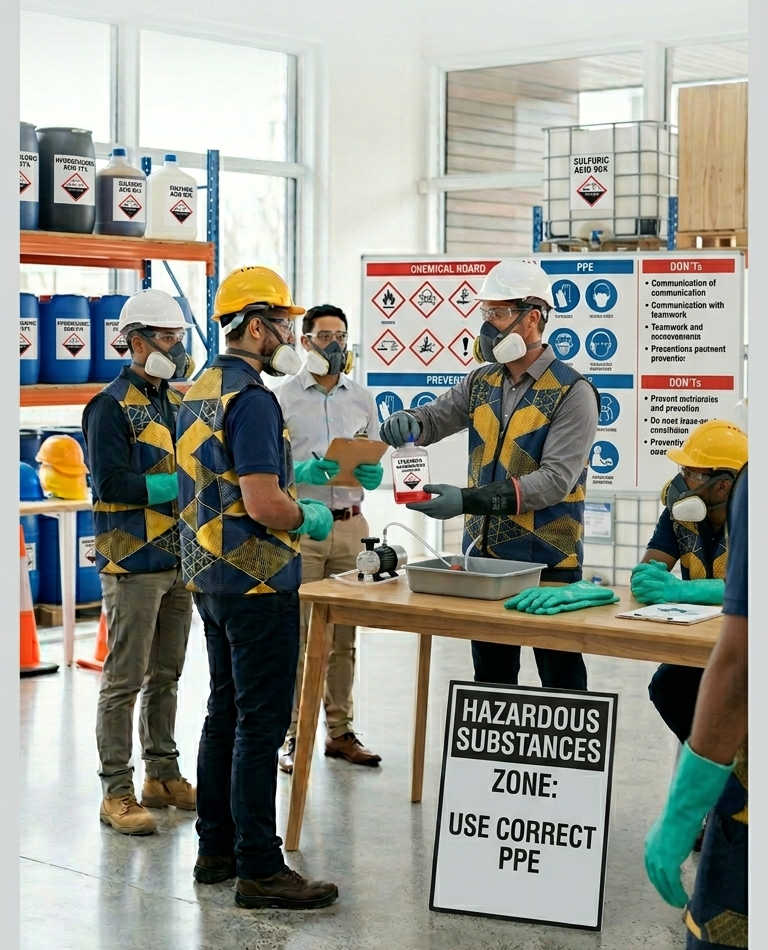
Hazard Communication and Job-Specific Requirements
Under 1910.1200(h), employers must provide effective information and training on hazardous chemicals in the work area at initial assignment and when a new chemical hazard not previously covered is introduced. Construction section 1926.59 applies those Hazard Communication requirements. These discussion aids do not establish that the employer has met every training or substance-specific requirement.
What This Discussion Does and Does Not Establish
- Use the material to discuss chemical hazards and the employer’s protective measures.
- Do not treat a toolbox talk, a signature, or a download as proof of regulatory compliance.
- Hazard Communication training must meet 1910.1200(h), applied to construction through 1926.59.
- Substance-specific standards may require additional assessment, controls, medical surveillance, and training.
Key OSHA Standards Referenced
- Construction Hazard Communication: 1926.59 applies 1910.1200, including employee information and training under paragraph (h).
- Asbestos construction work: 1926.1101.
- Inorganic arsenic: 1926.1118 and 1910.1018, subject to scope exclusions.
- Benzene: 1926.1128 and 1910.1028, subject to scope exclusions.
- Beryllium construction work: 1926.1124, subject to scope exclusions.
Check the complete standard and employer’s procedures for the actual work. Exposure limits, respirator requirements, and work methods are not interchangeable across these substances.
Additional OSHA Training Resources on Hazardous Substances
Download Free Hazardous Substances Toolbox Talks
Use the overview and substance resources for discussion alongside the employer’s work procedures and required training. Verify the current regulations and the protections for the actual operation before work. A completed attendance form records attendance, not competence or compliance.
Frequently Asked Questions About Hazardous Substances
Get clear answers about toolbox talks, safety topics, and training resources.
A discussion about a chemical hazard and the protections for the actual work. These resources introduce arsenic, asbestos, benzene, and beryllium. They do not replace chemical-specific procedures, required training, or the employer’s exposure assessment.
OSHA does not name this website or require this particular handout. Hazard Communication training under 1910.1200(h), applied to construction by 1926.59, must meet the standard’s content and timing requirements. Substance-specific rules may require more. Attendance at a discussion alone is not proof that those requirements are met.
Under 1910.1200(h)(1), effective information and training are required at initial assignment and whenever a new chemical hazard the employees have not previously been trained about is introduced into their work area. This is not a universal weekly-toolbox-talk rule. Check any additional substance-specific training requirements.
Choose someone prepared to explain the employer’s actual chemical hazards and protective measures and to answer questions or obtain qualified help. A supervisor title alone does not establish that required training or competence requirements are met.
Check the handout’s subject, sources, and revision against the current regulations and the employer’s procedures. Confirm that it applies to the actual chemical, operation, and workforce. A signature records attendance, not certification or regulatory compliance. Print settings determine whether separate pages appear on the front and back of a sheet.