
Biohazard and Infectious Disease Prevention Safety Training Toolbox Talks and Printable PDFs
Existing topic descriptions
Understanding Bacteria and Viruses in the Workplace: Infectious Disease Prevention Basics
Viruses and bacteria are both germs that can cause illness. Germs can spread from person to person and from surfaces or objects to people (CDC, About Handwashing). Use this topic to start a talk on how infections begin and how to cut down exposure at work.
How Bacteria and Viruses Spread: Understanding Workplace Disease Transmission
Germs can spread from person to person, from contaminated surfaces or objects, from animals, through insect bites, and through contaminated food or water (CDC). Blood and some other body fluids can spread bloodborne pathogens through the eyes, mouth, other mucous membranes, non-intact skin, or a puncture injury (29 CFR 1910.1030(b)). Respiratory viruses can also build up in indoor air where air movement is poor (CDC/NIOSH, Improving Air Circulation).
Recognizing Early Signs and Symptoms of Workplace Infections
Respiratory virus symptoms can include fever, chills, fatigue, cough, runny nose, and headache, among others. CDC advises staying home and away from others when you have symptoms, and returning to normal activities once symptoms are getting better overall and you have been fever-free for at least 24 hours without fever-reducing medication, then taking added precautions over the next 5 days, such as cleaner air, good hygiene, a well-fitted mask, distancing, or testing. People at higher risk of severe illness should seek health care promptly (CDC). Follow your employer’s policy on reporting illness.
Hidden Sources of Infection: Identifying Common Disease Carriers
You cannot tell by looking whether a person, surface, or material carries germs. OSHA’s bloodborne pathogens standard requires universal precautions to prevent contact with blood or other potentially infectious materials, and where body fluid types are hard to tell apart, all body fluids are treated as potentially infectious (29 CFR 1910.1030(d)(1)). CDC also notes that a person who is feeling better may still be able to spread a virus.
Why Face Masks Matter: Reducing Exposure to Airborne Infectious Diseases
CDC describes masks as an additional layer of protection against respiratory viruses, most helpful when illness is high in the community or someone nearby is sick or at higher risk. Protection varies with the type of mask and how well it fits, so check for gaps around the edges. Where there is occupational exposure to blood or other potentially infectious materials, the employer provides appropriate PPE at no cost, which can include face shields or masks and eye protection (29 CFR 1910.1030(d)(3)(i)).
How Vaccinations Support Workplace Health and Infection Prevention
Vaccines work by imitating an infection so the body can learn to defend itself without the dangers of a full-blown infection (CDC). CDC lists staying up to date with recommended immunizations as a core prevention strategy for respiratory illness. Under OSHA’s bloodborne pathogens standard, the hepatitis B vaccine series must be made available at no cost to employees with occupational exposure, within 10 working days of initial assignment, unless they are already immune, have completed the series, or the vaccine is medically contraindicated (29 CFR 1910.1030(f)).
Proper Handwashing Techniques for Effective Infection Control
CDC calls handwashing with soap one of the best ways to stay healthy. Wet hands with clean running water, apply soap, lather the backs of hands, between fingers, and under nails, scrub for at least 20 seconds, rinse well, and dry with a clean towel or air dryer. If soap and water are not readily available, use a hand sanitizer with at least 60% alcohol. Where OSHA’s bloodborne pathogens standard applies, wash hands immediately or as soon as feasible after removing gloves or PPE, and after contact with blood or other potentially infectious materials (29 CFR 1910.1030(d)(2)(v)-(vi)).
Workplace Ventilation and Air Quality: Key Factors in Disease Prevention
CDC/NIOSH advises that bringing outdoor air indoors helps dilute respiratory viral particles produced by people in the space, and that air movement reduces build-up of germs in one area. At a minimum, make sure the HVAC system supplies at least the outdoor air required by ventilation codes. Changes to HVAC equipment should be made with professionals experienced in HVAC design and commissioning.
Social Distancing Best Practices for Workplace Infection Prevention
CDC lists physical distancing as an additional prevention strategy that adds a layer of protection, especially when respiratory viruses are causing a lot of illness in the community, when people nearby are sick or were recently exposed, or when they are at higher risk of severe illness. CDC also advises people with respiratory virus symptoms to stay home and away from others.
Bloodborne Pathogen Awareness: Protecting Workers from Exposure Risks
OSHA’s bloodborne pathogens standard (29 CFR 1910.1030) applies where employees have occupational exposure to blood or other potentially infectious materials. The employer must have a written exposure control plan, use universal precautions, provide appropriate PPE at no cost, make the hepatitis B vaccine available, and train employees at initial assignment and at least annually. Contaminated needles and other contaminated sharps must not be bent, recapped, or removed unless the employer can show no alternative is feasible or a specific medical or dental procedure requires it (29 CFR 1910.1030(d)(2)(vii)). Contaminated sharps must be discarded immediately or as soon as feasible in closable, puncture-resistant, leak-proof, and labeled or color-coded containers (1910.1030(d)(4)(iii)(A)).
Preventing Vector-Borne Diseases in Outdoor and High-Risk Work Environments
CDC advises reducing exposure to ticks and mosquitoes: use an EPA-registered insect repellent with DEET, picaridin, IR3535, oil of lemon eucalyptus, para-menthane-diol, or 2-undecanone, and wear loose-fitting long sleeves and pants. Treat clothing and gear with 0.5% permethrin or buy permethrin-treated items, avoid brushy areas with high grass and leaf litter, check clothing, gear, and pets for ticks after coming indoors, and shower soon after being outdoors.
Zoonotic Diseases Explained: Preventing Illnesses Transmitted from Animals to Humans
Zoonotic diseases are caused by germs that spread between animals and people. CDC lists direct contact (for example bites, scratches, or contact with saliva, blood, urine, or feces), indirect contact with areas or objects contaminated by animals, insect bites, contaminated food, and contaminated water as ways they spread. Wash hands after touching animals, animal feed, or animal waste (CDC).
Explore Additional Workplace Training Resources on Hazardous Biological Pathogens
More topics may be added over time. For current requirements and guidance, check with your employer, OSHA (osha.gov), and the CDC (cdc.gov).
Workers can be exposed to biological hazards, such as germs, contaminated surfaces, and infectious materials like blood, in many workplaces. This page lists topic summaries and one downloadable overview PDF with an attendance sign-in sheet, for toolbox talks and workplace meetings. Individual talks are not posted separately yet. The summaries are discussion aids and do not replace the training and requirements that OSHA and your employer set.

Workplace Biohazard Safety Training Toolbox Talks For Employees
Understanding Bacteria and Viruses in the Workplace: Infectious Disease Prevention Basics
Viruses and bacteria are both germs that can cause illness. Germs can spread from person to person and from surfaces or objects to people (CDC, About Handwashing). Use this topic to start a talk on how infections begin and how to cut down exposure at work.
How Bacteria and Viruses Spread: Understanding Workplace Disease Transmission
Germs can spread from person to person, from contaminated surfaces or objects, from animals, through insect bites, and through contaminated food or water (CDC). Blood and some other body fluids can spread bloodborne pathogens through the eyes, mouth, other mucous membranes, non-intact skin, or a puncture injury (29 CFR 1910.1030(b)). Respiratory viruses can also build up in indoor air where air movement is poor (CDC/NIOSH, Improving Air Circulation).
Recognizing Early Signs and Symptoms of Workplace Infections
Respiratory virus symptoms can include fever, chills, fatigue, cough, runny nose, and headache, among others. CDC advises staying home and away from others when you have symptoms, and returning to normal activities once symptoms are getting better overall and you have been fever-free for at least 24 hours without fever-reducing medication, then taking added precautions over the next 5 days, such as cleaner air, good hygiene, a well-fitted mask, distancing, or testing. People at higher risk of severe illness should seek health care promptly (CDC). Follow your employer's policy on reporting illness.
Hidden Sources of Infection: Identifying Common Disease Carriers
You cannot tell by looking whether a person, surface, or material carries germs. OSHA's bloodborne pathogens standard requires universal precautions to prevent contact with blood or other potentially infectious materials, and where body fluid types are hard to tell apart, all body fluids are treated as potentially infectious (29 CFR 1910.1030(d)(1)). CDC also notes that a person who is feeling better may still be able to spread a virus.
Why Face Masks Matter: Reducing Exposure to Airborne Infectious Diseases
CDC describes masks as an additional layer of protection against respiratory viruses, most helpful when illness is high in the community or someone nearby is sick or at higher risk. Protection varies with the type of mask and how well it fits, so check for gaps around the edges. Where there is occupational exposure to blood or other potentially infectious materials, the employer provides appropriate PPE at no cost, which can include face shields or masks and eye protection (29 CFR 1910.1030(d)(3)(i)).
How Vaccinations Support Workplace Health and Infection Prevention
Vaccines work by imitating an infection so the body can learn to defend itself without the dangers of a full-blown infection (CDC). CDC lists staying up to date with recommended immunizations as a core prevention strategy for respiratory illness. Under OSHA's bloodborne pathogens standard, the hepatitis B vaccine series must be made available at no cost to employees with occupational exposure, within 10 working days of initial assignment, unless they are already immune, have completed the series, or the vaccine is medically contraindicated (29 CFR 1910.1030(f)).
Proper Handwashing Techniques for Effective Infection Control
CDC calls handwashing with soap one of the best ways to stay healthy. Wet hands with clean running water, apply soap, lather the backs of hands, between fingers, and under nails, scrub for at least 20 seconds, rinse well, and dry with a clean towel or air dryer. If soap and water are not readily available, use a hand sanitizer with at least 60% alcohol. Where OSHA's bloodborne pathogens standard applies, wash hands immediately or as soon as feasible after removing gloves or PPE, and after contact with blood or other potentially infectious materials (29 CFR 1910.1030(d)(2)(v)-(vi)).
Workplace Ventilation and Air Quality: Key Factors in Disease Prevention
CDC/NIOSH advises that bringing outdoor air indoors helps dilute respiratory viral particles produced by people in the space, and that air movement reduces build-up of germs in one area. At a minimum, make sure the HVAC system supplies at least the outdoor air required by ventilation codes. Changes to HVAC equipment should be made with professionals experienced in HVAC design and commissioning.
Social Distancing Best Practices for Workplace Infection Prevention
CDC lists physical distancing as an additional prevention strategy that adds a layer of protection, especially when respiratory viruses are causing a lot of illness in the community, when people nearby are sick or were recently exposed, or when they are at higher risk of severe illness. CDC also advises people with respiratory virus symptoms to stay home and away from others.
Bloodborne Pathogen Awareness: Protecting Workers from Exposure Risks
OSHA's bloodborne pathogens standard (29 CFR 1910.1030) applies where employees have occupational exposure to blood or other potentially infectious materials. The employer must have a written exposure control plan, use universal precautions, provide appropriate PPE at no cost, make the hepatitis B vaccine available, and train employees at initial assignment and at least annually. Contaminated needles and other contaminated sharps must not be bent, recapped, or removed unless the employer can show no alternative is feasible or a specific medical or dental procedure requires it (29 CFR 1910.1030(d)(2)(vii)). Contaminated sharps must be discarded immediately or as soon as feasible in closable, puncture-resistant, leak-proof, and labeled or color-coded containers (1910.1030(d)(4)(iii)(A)).
Preventing Vector-Borne Diseases in Outdoor and High-Risk Work Environments
CDC advises reducing exposure to ticks and mosquitoes: use an EPA-registered insect repellent with DEET, picaridin, IR3535, oil of lemon eucalyptus, para-menthane-diol, or 2-undecanone, and wear loose-fitting long sleeves and pants. Treat clothing and gear with 0.5% permethrin or buy permethrin-treated items, avoid brushy areas with high grass and leaf litter, check clothing, gear, and pets for ticks after coming indoors, and shower soon after being outdoors.
Zoonotic Diseases Explained: Preventing Illnesses Transmitted from Animals to Humans
Zoonotic diseases are caused by germs that spread between animals and people. CDC lists direct contact (for example bites, scratches, or contact with saliva, blood, urine, or feces), indirect contact with areas or objects contaminated by animals, insect bites, contaminated food, and contaminated water as ways they spread. Wash hands after touching animals, animal feed, or animal waste (CDC).
Explore Additional Workplace Training Resources on Hazardous Biological Pathogens
More topics may be added over time. For current requirements and guidance, check with your employer, OSHA (osha.gov), and the CDC (cdc.gov).
Support Workplace Biohazard Safety Resources
ToolboxTalk.com provides free resources covering biohazards, infectious disease prevention, and practical workplace safety practices. If your company provides biohazard safety equipment, services, or training, explore partnership opportunities with ToolboxTalk.
Building a Strong Workplace Infection Control Culture
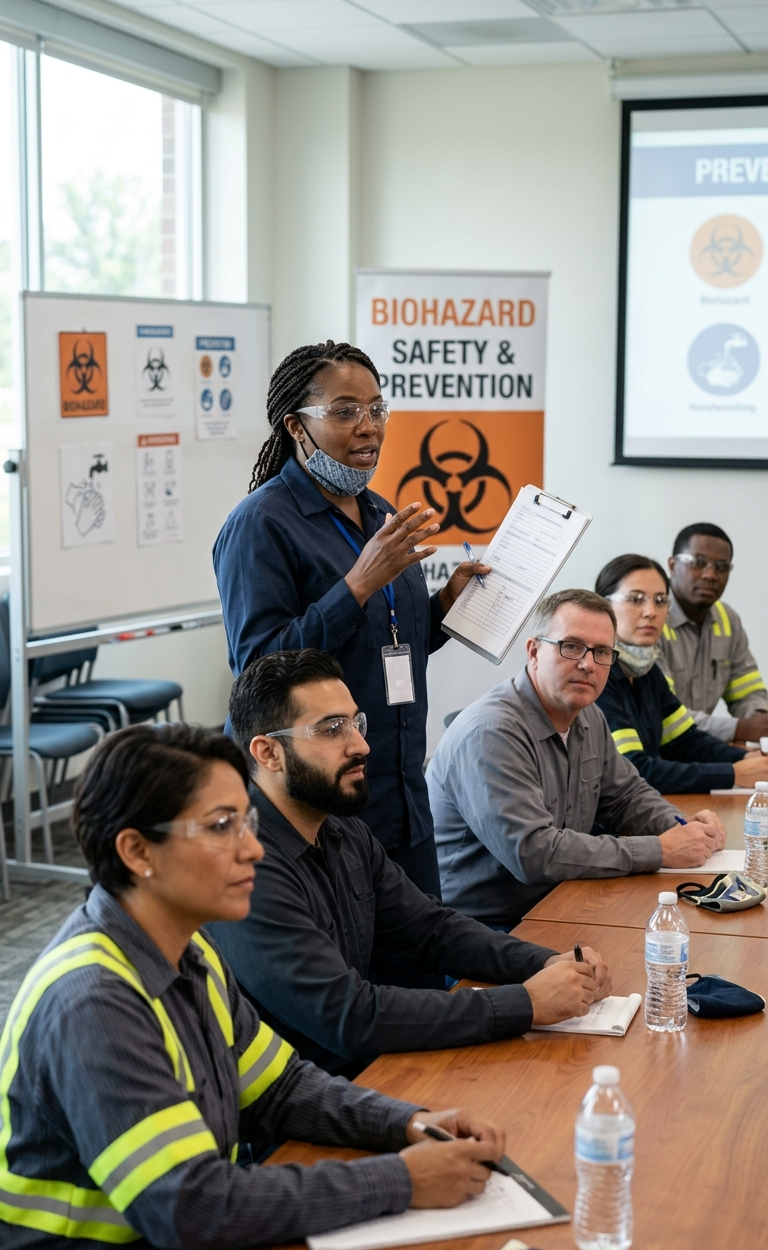
- Training helps workers recognize biological hazards and know the controls and procedures their employer uses. Where employees have occupational exposure to blood or other potentially infectious materials, OSHA requires a written exposure control plan and training at the time of initial assignment and at least annually (29 CFR 1910.1030(c)(1)(i), (g)(2)(ii)).
- CDC’s core prevention strategies for respiratory illness are staying up to date with recommended immunizations, good hygiene such as handwashing and cleaning commonly touched surfaces, cleaner air, and staying home and away from others when sick. A toolbox talk is a discussion aid and does not replace required training.
Preparing Workers for Emerging Biological Hazards and Public Health Risks
Public health guidance can change. Before a talk, check current guidance from the CDC and OSHA’s bloodborne pathogens guidance, and follow your employer’s policies. CDC publishes separate guidance for healthcare settings.

Support Workplace Compliance and Biological Hazard Safety Requirements
Employers are responsible for their own safety programs. Where OSHA's bloodborne pathogens standard (29 CFR 1910.1030) applies, the exposure control plan, training, PPE, and hepatitis B vaccination requirements in that standard apply. These topic summaries are general information. Double-check all regulations and safety requirements with your employer and OSHA.
Download Free Biohazard and Infectious Disease Prevention Toolbox Talks and Printable PDFs
Download the overview PDF for a list of biohazard and infectious disease topics and an attendance sign-in sheet for toolbox talks and workplace meetings. Individual talks are not posted separately yet. The PDF is a discussion aid and does not replace employer training or OSHA requirements.
Frequently Asked Questions About Infectious Disease Prevention Toolbox Talk for Employees
Get clear answers about toolbox talks, safety topics, and training resources.
Biohazards are biological hazards at work, such as germs (viruses, bacteria, parasites, and fungi, per CDC) and blood or other potentially infectious materials (29 CFR 1910.1030(b)). Training helps workers understand how these hazards spread, how to avoid exposure, and what to do after an exposure. Where employees have occupational exposure to blood or other potentially infectious materials, OSHA requires training at initial assignment and at least annually (29 CFR 1910.1030(g)(2)(ii)).
Employees whose jobs may involve contact with blood or other potentially infectious materials must be trained under OSHA’s bloodborne pathogens standard (29 CFR 1910.1030). Hygiene and respiratory illness topics apply to most workplaces. These summaries are discussion material for supervisors and crews.
A toolbox talk is a short discussion that can reinforce topics such as handwashing, staying home when sick, cleaner air, and the controls your employer uses. It does not replace required training or your employer’s exposure control plan.
For CDC prevention guidance, see Preventing Respiratory Illnesses.
The topics are: bacteria and viruses, how germs spread, early signs and symptoms, hidden sources of infection, face masks, vaccinations, handwashing, ventilation, social distancing, bloodborne pathogens, vector-borne diseases, and zoonotic diseases. Individual talks are not posted separately yet. The overview PDF lists the topics.
Download the overview PDF from the Browse resources list at the top of this page. It lists the topics and includes an attendance sign-in sheet. Individual talks are not posted separately yet.