
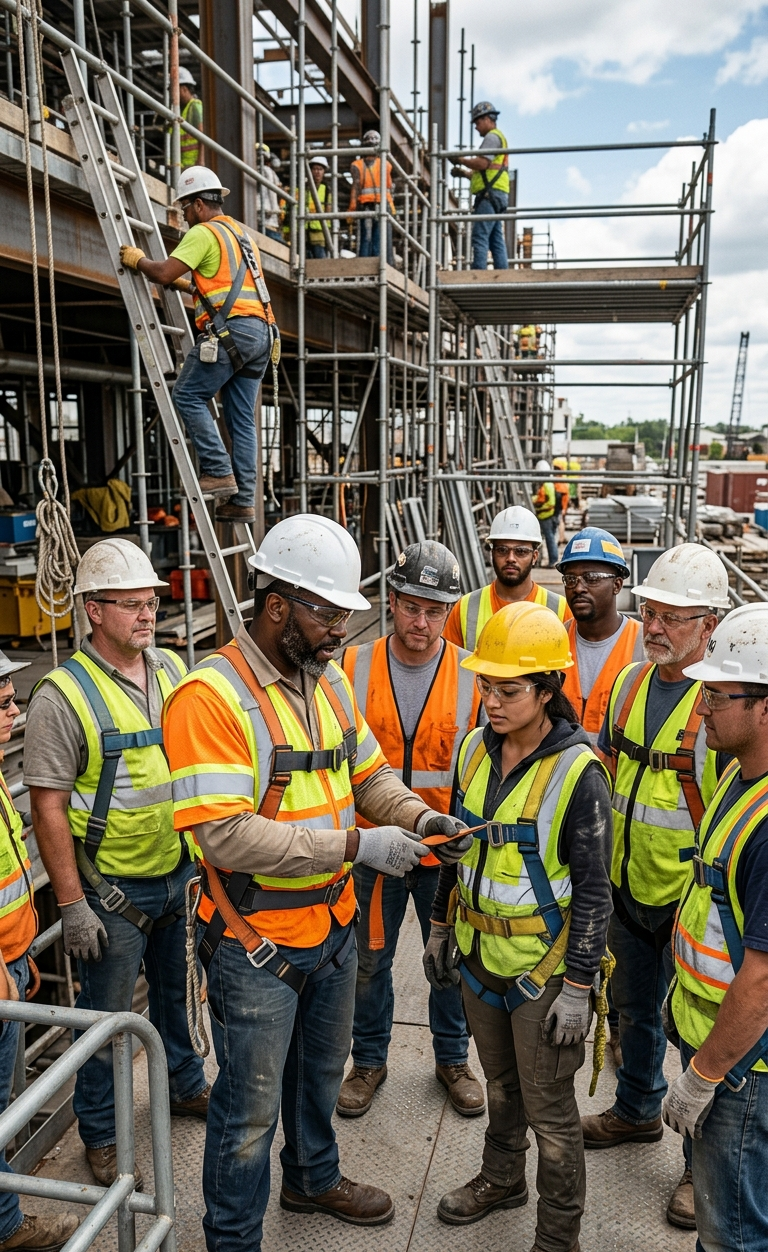
Fall Protection and Fall Prevention Safety Training Guide For Workers
Slips, Trips, and Falls Statistics Toolbox Talk: Workplace Injury Awareness Guide
OSHA says falls are among the most common causes of serious work-related injuries and deaths. Use this topic to start a talk on slip, trip, and fall hazards at your worksite. For current injury statistics, see OSHA and the Bureau of Labor Statistics.
Slips Prevention Safety Training: How to Reduce Workplace Slip Hazards Effectively
In general industry, workroom floors must be kept clean and, to the extent feasible, dry, and walking-working surfaces must be kept free of hazards such as spills, leaks, snow, and ice. Hazardous conditions must be corrected before the surface is used again, or guarded if they cannot be fixed right away (29 CFR 1910.22(a), (d)). Construction work has its own requirements, so check with your employer.
Workplace Footwear Safety Toolbox Talk: Preventing Slips Through Proper Shoes
OSHA requires employees to use protective footwear when working in areas where there is a danger of foot injuries from falling or rolling objects or objects piercing the sole, or to protect against an electrical hazard that remains after other protective measures (29 CFR 1910.136(a), general industry). In construction, safety-toe footwear must meet ANSI Z41.1 (29 CFR 1926.96). Ask your employer what footwear your job requires.
Trip Hazard Prevention Toolbox Talk: Keeping Walkways Safe on Job Sites
In general industry, walking-working surfaces must be kept clean and orderly and free of hazards such as sharp or protruding objects and loose boards (29 CFR 1910.22(a)). In construction, scrap lumber with protruding nails and other debris must be kept cleared from work areas, passageways, and stairs (29 CFR 1926.25(a)).
Full Body Harness Safety Toolbox Talk: Do’s and Don’ts for Fall Protection Gear
A personal fall arrest system consists of a body harness, anchorage, and connector (29 CFR 1910.140(b)). Body belts are not acceptable as part of a personal fall arrest system. In construction, the harness attachment point must be in the center of the wearer's back near shoulder level, or above the wearer's head (29 CFR 1926.502(d)(17)). In general industry, it must be in the center of the back near shoulder level, and the pre-sternal position is allowed only if free fall is limited to 2 feet or less (29 CFR 1910.140(c)(22)). In construction, inspect the system for wear, damage, and deterioration before each use; in general industry, before initial use during each workshift. A system that has stopped a fall must be removed from service until a competent person determines it is undamaged (29 CFR 1926.502(d)(19), (21); 1910.140(c)(17), (18)).
Safety Lanyards Toolbox Talk: Proper Use and Common Mistakes to Avoid
In construction, lanyards and vertical lifelines must have a minimum breaking strength of 5,000 pounds. Only locking snaphooks may be used, and unless designed for it, a snaphook must not be connected directly to webbing, rope, or wire rope, to another snaphook, or to a D-ring to which another snaphook or connector is attached (29 CFR 1926.502(d)(5), (6), (9)). With a harness, the system must limit the maximum arresting force on the worker to 1,800 pounds (29 CFR 1926.502(d)(16)). General industry has similar requirements in 29 CFR 1910.140.
Fall Arrest Anchor Point Safety Toolbox Talk: Secure Connection Best Practices
Anchorages used for personal fall arrest equipment must be capable of supporting at least 5,000 pounds for each worker attached, or be designed, installed, and used under the supervision of a qualified person as part of a complete system with a safety factor of at least two. They must be independent of any anchorage used to support or suspend platforms (29 CFR 1926.502(d)(15); general industry: 29 CFR 1910.140(c)(12), (13)). In construction, a personal fall arrest system must not be attached to a guardrail system (29 CFR 1926.502(d)(23)).
Fall Clearance Distance Toolbox Talk: How to Prevent Ground Impact in Falls
In construction, a personal fall arrest system must be rigged so the worker can neither free fall more than 6 feet nor contact a lower level, and must limit the deceleration distance to 3.5 feet (29 CFR 1926.502(d)(16)). General industry is similar, with one difference: a free fall of more than 6 feet is allowed only if the employer can demonstrate the manufacturer designed and tested the system for it, and the 3.5-foot deceleration limit still applies (29 CFR 1910.140(d)). Ask your supervisor or competent person to confirm the clearance below the work area before using a system.
Floor Opening Safety Toolbox Talk: Protecting Workers from Hidden Fall Hazards
In construction, workers must be protected from falling through holes more than 6 feet above a lower level by personal fall arrest systems, covers, or guardrail systems, and from tripping into or stepping through holes by covers (29 CFR 1926.501(b)(4)). Covers must support at least twice the weight imposed, be secured, and be color coded or marked "HOLE" or "COVER" (29 CFR 1926.502(i)). In general industry, holes 4 feet or more above a lower level need covers, guardrails, travel restraint, or personal fall arrest systems (29 CFR 1910.28(b)(3)).
Ladder Fall Prevention Toolbox Talk: Safe Use of Portable Ladders at Work
For portable ladders in construction, the side rails must extend at least 3 feet above the upper landing. When that is not possible because of the ladder's length, the ladder must be secured at its top to a rigid support that will not deflect, and a grasping device, such as a grabrail, must be provided. A non-self-supporting ladder is set at an angle with its foot approximately one-quarter of the working length from the top support. Face the ladder when climbing or descending, and do not carry any object or load that could cause you to lose balance and fall (29 CFR 1926.1053(b)(1), (5)(i), (20), (22)). See the Ladder Safety category for more.
Practical Fall Prevention Safety Resources
ToolboxTalk.com offers a free fall protection overview PDF with an attendance sign-in sheet and short topic summaries based on OSHA and other cited sources. If your company provides safety equipment, services or training, explore partnership opportunities with ToolboxTalk.
Why Regular Fall Protection Toolbox Talks Improve Workplace Safety Culture
A short talk before work starts gives a crew a routine chance to review the fall hazards on that job. OSHA’s construction standard requires employers to provide a training program for each employee who might be exposed to fall hazards (29 CFR 1926.503(a)(1)). A toolbox talk is a discussion aid and does not replace that training.
Supervisors can use these topics to review the site’s fall protection systems, equipment inspection, and rescue arrangements. Employers must provide for prompt rescue of employees in the event of a fall, or ensure employees can rescue themselves (29 CFR 1926.502(d)(20)).
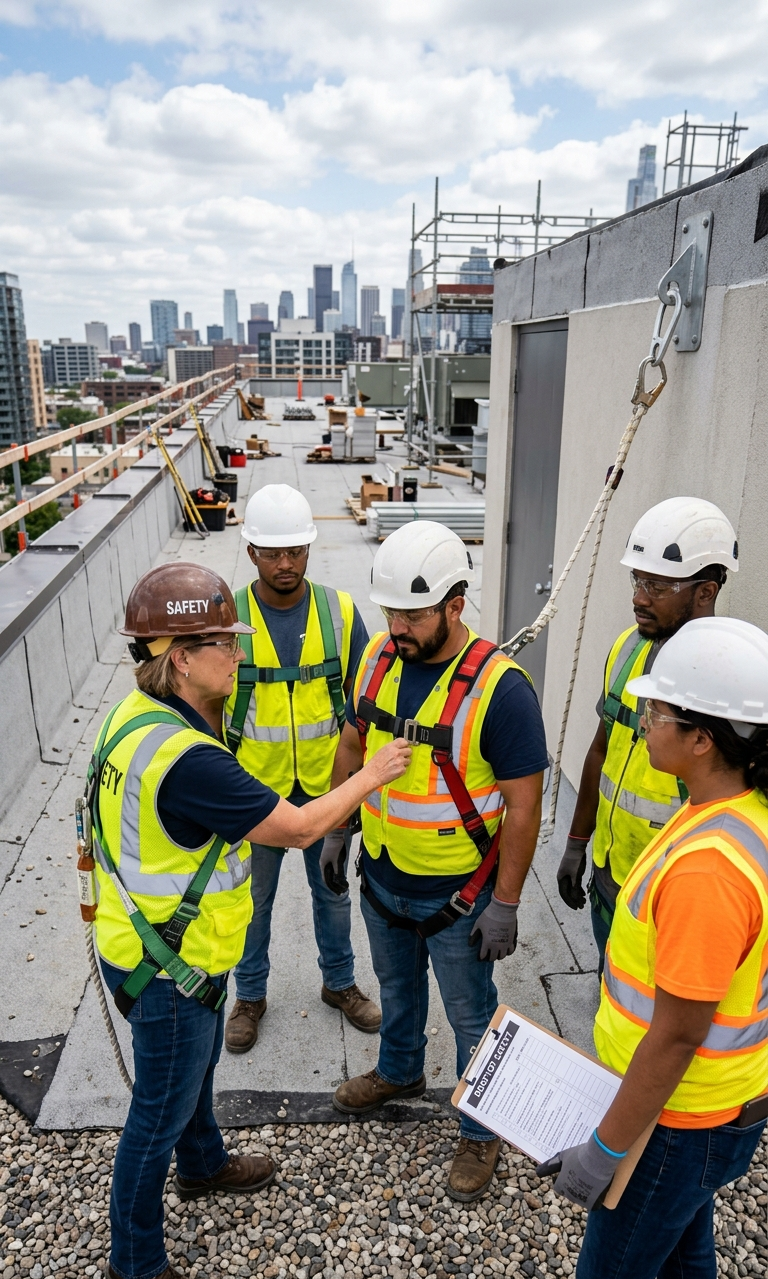
Key Benefits Workers Gain From Free Fall Prevention and Protection Toolbox Talks
The topics cover slips and trips, harnesses, lanyards, anchor points, fall clearance, floor openings, and portable ladders. Workers can learn what the rules require, for example that personal fall arrest systems are inspected before use and that holes are covered or guarded.
The goal is to help workers recognize hazards and ask their employer about the systems and procedures at their site.
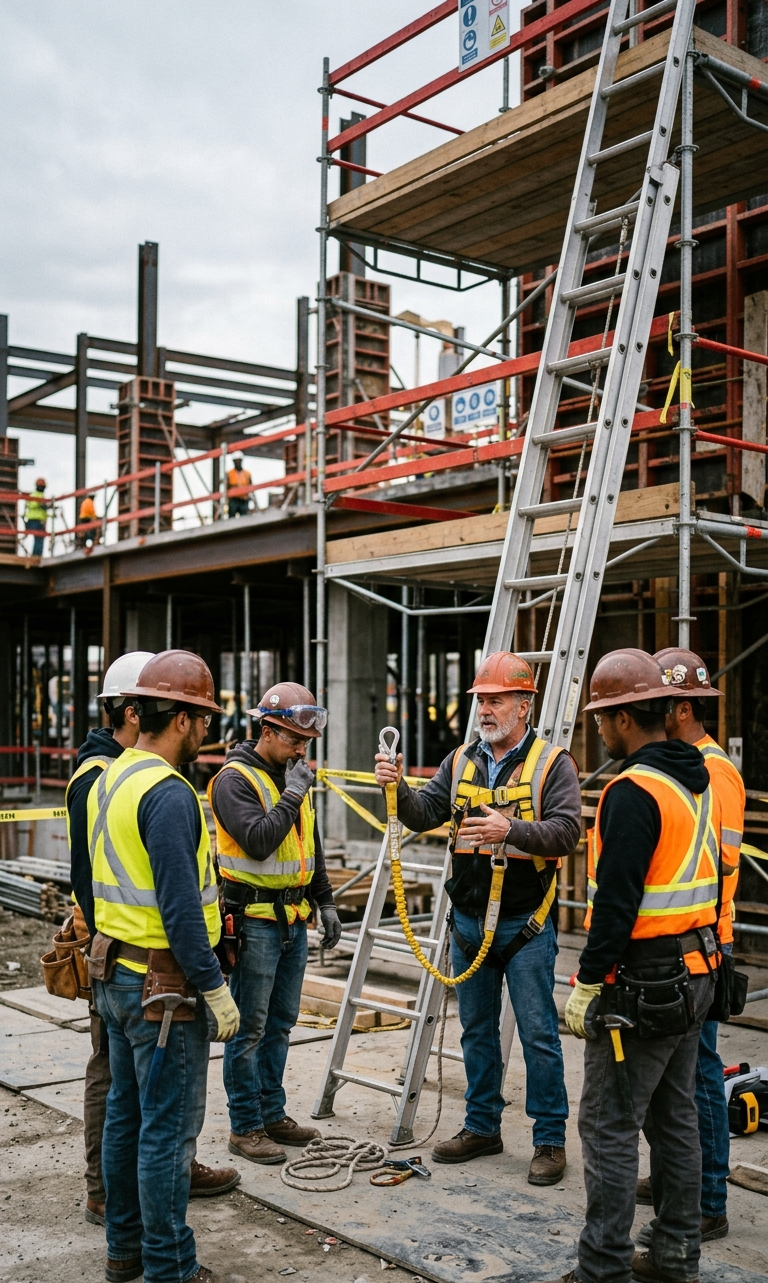
Compliance & Safe Work Practice Alignment for Fall Protection and Fall Prevention Toolbox Talks
Employers are responsible for their own fall protection programs. Requirements differ for construction (29 CFR 1926 Subpart M, which generally applies at 6 feet) and general industry (29 CFR 1910 Subpart D, which generally applies at 4 feet), and some work is covered by other rules. These topic summaries are general information. Double-check all regulations and safety requirements with your employer and OSHA.
Free Downloads & Safety Action Tools for Fall Protection and Fall Prevention Toolbox Talks
Download the overview PDF for a list of fall protection topics and an attendance sign-in sheet for toolbox talks and workplace meetings. Individual talks are not posted separately yet. The PDF is a discussion aid and does not replace employer training or OSHA requirements.
Frequently Asked Questions (FAQs) Free Fall Protection and Fall Prevention Toolbox Talks for Workers
Get clear answers about toolbox talks, safety topics, and training resources.
A fall protection toolbox talk is a short safety meeting about fall hazards and how to prevent them, such as unprotected edges, holes, ladders, and slippery or cluttered walking surfaces, and the correct use of fall protection equipment. See OSHA Fall Protection for details.
OSHA says falls are among the most common causes of serious work-related injuries and deaths. Since 2012, OSHA has partnered with NIOSH and the National Occupational Research Agenda (NORA) Construction Sector on a Fall Prevention Campaign with three steps: plan ahead to get the job done safely, provide the right equipment, and train everyone to use the equipment safely (OSHA).
How often to hold a talk is up to your employer. OSHA’s construction standard requires fall hazard training for each employee who might be exposed to fall hazards, and retraining when changes in the workplace or equipment make earlier training obsolete or when an employee’s knowledge or use of fall protection shows gaps (29 CFR 1926.503(a), (c)). A toolbox talk does not replace that training.
OSHA’s construction fall-protection standard requires guardrail systems, safety net systems, or personal fall arrest systems for each employee on a walking or working surface with an unprotected side or edge 6 feet or more above a lower level (29 CFR 1926.501(b)(1)). In general industry the trigger height is 4 feet (29 CFR 1910.28(b)(1)). OSHA also requires holes and floor openings to be covered or guarded.
Workers learn how to recognize fall hazards and the procedures that reduce them. OSHA requires a fall-protection training program for each construction employee who might be exposed to fall hazards (29 CFR 1926.503(a)(1)). In general industry, employers must train each employee who uses personal fall protection systems or is required to be trained (29 CFR 1910.30(a)).