
Free Portable Tool and Equipment Safety Toolbox Talk For Training and Injury Prevention Topics
Existing topic descriptions
Portable Tool Safety Toolbox Talk: Safe Abrasive Wheel Mounting Procedures
Immediately before mounting, the user must closely inspect and sound every abrasive wheel (ring test) to make sure it was not damaged in transit, storage, or otherwise, and a wheel that sounds cracked (dead) must not be used. Check that the machine’s spindle speed does not exceed the maximum operating speed marked on the wheel (29 CFR 1910.215(d)(1)). Abrasive wheels may be used only on machines with the required safety guards (1910.215(b); 1910.243(c)(1)). In construction, guards must be fitted when a power tool is designed to accommodate them (1926.300(b)(1)).
Bench and Pedestal Grinder Toolbox Talk: How to Mount Abrasive Wheels Safely
All abrasive wheels must be mounted between flanges that are not less than one-third the diameter of the wheel, with limited exceptions for some cutting-off wheels (29 CFR 1910.215(c)(1)). Flanges must be accurate and in good balance, with no rough surfaces or sharp edges, and both flanges between which a wheel is mounted must generally have the same diameter and equal bearing surface (1910.215(c)). Blotters (compressible washers) must be used between the flanges and the wheel except for the wheel types the rule exempts, and all contact surfaces of wheels, blotters, and flanges must be flat and free of foreign matter (1910.215(c)(6), (d)(3)).
Bench and Pedestal Grinder Safety Toolbox Talk: Essential Safe Operating Practices
On offhand grinding machines, work rests must be used to support the work. They must be rigid, adjustable to compensate for wheel wear, and kept adjusted closely to the wheel with a maximum opening of one-eighth inch. The work rest must be securely clamped after each adjustment, and adjustments must not be made with the wheel in motion (29 CFR 1910.215(a)(4)). The guard must cover the spindle end, nut, and flange projections, and on bench and floor stands the angular exposure of the wheel should not exceed 90 degrees or one-fourth of the periphery (1910.215(a)(2), (b)(3); construction 1926.300(b)(7)-(8)). Employees exposed to flying particles must be provided eye or face protection (1910.133(a); 1926.102(a); 1926.300(c)).
Compressed Air Safety Toolbox Talk: Preventing Injuries from Air Blowers
Compressed air must not be used for cleaning except where it is reduced to less than 30 p.s.i. and then only with effective chip guarding and personal protective equipment (29 CFR 1910.242(b); 1926.302(b)(4)). Construction rules exempt concrete form, mill scale, and similar cleaning from the 30 p.s.i. limit (1926.302(b)(4)). Eye or face protection is part of the required protective equipment for flying particles (1910.133(a); 1926.102(a)). As a general practice, never point compressed air at yourself or another person. That practice is general safety advice rather than text in those OSHA sections.
Compressed Air Hose Safety Toolbox Talk: Preventing Hose Failures and Whip Hazards
In general industry, hose and hose connections used for compressed air must be designed for the pressure and service to which they are subjected, and a tool retainer must be installed on utilization equipment that could otherwise eject the tool (29 CFR 1910.243(b)). In construction, pneumatic tools must be secured to the hose or whip by a positive means to prevent accidental disconnection, and the manufacturer’s safe operating pressure for hoses, valves, and fittings must not be exceeded (1926.302(b)(1), (5)). Hoses may not be used to hoist or lower tools, and hoses exceeding 1/2-inch inside diameter must have a safety device at the source of supply or branch line to reduce pressure in case of hose failure (1926.302(b)(6)-(7)).
Portable Circular Saw Safety Toolbox Talk: Safe Cutting Techniques for Every Job
Portable power-driven circular saws with a blade diameter greater than 2 inches must have guards above and below the base plate or shoe. The upper guard covers the saw to the depth of the teeth, and the lower guard must cover the saw to the depth of the teeth and automatically and instantly return to the covering position when the tool is withdrawn from the work (29 CFR 1910.243(a)(1); 1926.304(d)). Hand-held circular saws must have a constant pressure switch that shuts off the power when pressure is released (1910.243(a)(2)(i); 1926.300(d)(3)). Cracked saws must be removed from service (1910.243(a)(4)).
Radial Arm Saw Safety Toolbox Talk: Safe Operation and Hazard Prevention
Radial saws must have an upper hood that completely encloses the upper portion of the blade down to the end of the saw arbor, and the lower exposed portion of the blade must be guarded to the full diameter of the blade by a device that adjusts to the thickness of the stock (29 CFR 1910.213(h)(1); 1926.304(g)). Radial saws used for ripping must have nonkickback fingers or dogs on both sides of the saw (1910.213(h)(2)), an adjustable stop must prevent forward travel of the blade beyond the position needed to complete the cut in repetitive operations ((h)(3)), and the front of the unit must sit slightly higher than the rear so the cutting head returns gently ((h)(4)). Ripping and ploughing must be against the direction in which the saw turns ((h)(5)).
Table Saw Safety Toolbox Talk: Preventing Kickback and Blade Contact Injuries
Each hand-fed circular ripsaw must be guarded by a hood that encloses the saw above the table and above the material being cut and adjusts to the thickness of the material, (29 CFR 1910.213(c)(1); 1926.304(i)). In general industry it must also have a spreader and nonkickback fingers or dogs (1910.213(c)(2)-(3)). Hand-fed circular crosscut table saws must be guarded by a hood (1910.213(d)(1); 1926.304(h)). Push sticks or push blocks must be provided at the workplace in sizes and types suitable for the work (1910.213(s)(9)). Dull, badly set, improperly filed, or improperly tensioned saws must be removed from service immediately, and cracked saws removed from service ((s)(1), (s)(7)).
Band Saw Safety Toolbox Talk: Safe Cutting Practices for Shop and Industrial Work
All portions of a bandsaw blade must be enclosed or guarded except the working portion of the blade between the bottom of the guide rolls and the table, and bandsaw wheels must be fully encased (29 CFR 1910.213(i)(1)). Each bandsaw must have a tension control device that indicates the proper tension for the standard saws used on the machine (1910.213(i)(2)). Dull, badly set, improperly filed, or improperly tensioned saws must be removed from service immediately, and cracked saws removed from service (1910.213(s)(1), (s)(7)). In construction, woodworking tools must meet 1926.304, including ANSI O1.1 (1926.304(f)).
Chainsaw Safety Toolbox Talk: Safe Cutting Practices for Outdoor and Industrial Work
Hand-held gasoline-powered chain saws must have a constant pressure throttle control that shuts off power to the saw chain when pressure is released, and electric, hydraulic, or pneumatic chain saws must have a constant pressure switch or control that shuts off power when pressure is released (29 CFR 1910.243(a)(2)(i); 1926.300(d)(3)). Employees using power tools and exposed to falling, flying, abrasive, and splashing objects or harmful dusts must be provided the PPE needed to protect them (1926.300(c); 1910.132(a)). Logging operations are covered separately by 1910.266. Following the manufacturer’s instructions for kickback prevention, chain maintenance, and cutting technique is general advice, not text in those sections.
Handheld Jigsaw Safety Toolbox Talk: Safe Cutting for Precision Work
Hand-held jigsaws with blade shanks greater than a nominal one-fourth inch must have a constant pressure switch or control, and those with blade shanks one-fourth inch wide or less may have a positive on-off control or a constant pressure control (29 CFR 1910.243(a)(2)(ii)-(iii)). The operating control must be located to minimize the possibility of accidental operation if that would be a hazard (1910.243(a)(2)(iv)). In construction, switch requirements are in 1926.300(d), electric tools must be double insulated or grounded (1926.302(a)(1)), and tools must be maintained in safe condition (1926.300(a)).
Chop Saw and Miter Saw Safety Toolbox Talk: Safe Cutting Practices for Accurate Results
Each swing cutoff saw must have a hood that completely encloses the upper half of the saw, the arbor end, and the point of operation at all positions of the saw, and the hood must automatically cover the lower portion of the blade. The same requirements apply to sliding cutoff saws mounted above the table (29 CFR 1910.213(g)(1)). Each swing cutoff saw must have an effective device that automatically returns the saw to the back of the table when released, and limit chains or equally effective devices must prevent the saw from swinging beyond the front or back edges of the table (1910.213(g)(2)-(3)). Employees exposed to flying particles must be provided eye or face protection (1910.133(a); 1926.102(a); 1926.300(c)).
Portable tools and equipment are used on construction sites, maintenance projects, warehouses, and industrial workplaces. This directory summarizes OSHA rules for hand and power tool guarding, compressed air, abrasive wheels, and saws. The overview PDF lists the topics in this section and includes a sign-in sheet that records attendance only.
Download Your Free Portable Tool and Equipment Safety Toolbox Talk PDF
Portable Tool Safety Toolbox Talk: Safe Abrasive Wheel Mounting Procedures
Immediately before mounting, the user must closely inspect and sound every abrasive wheel (ring test) to make sure it was not damaged in transit, storage, or otherwise, and a wheel that sounds cracked (dead) must not be used. Check that the machine's spindle speed does not exceed the maximum operating speed marked on the wheel (29 CFR 1910.215(d)(1)). Abrasive wheels may be used only on machines with the required safety guards (1910.215(b); 1910.243(c)(1)). In construction, guards must be fitted when a power tool is designed to accommodate them (1926.300(b)(1)).
Bench and Pedestal Grinder Toolbox Talk: How to Mount Abrasive Wheels Safely
All abrasive wheels must be mounted between flanges that are not less than one-third the diameter of the wheel, with limited exceptions for some cutting-off wheels (29 CFR 1910.215(c)(1)). Flanges must be accurate and in good balance, with no rough surfaces or sharp edges, and both flanges between which a wheel is mounted must generally have the same diameter and equal bearing surface (1910.215(c)). Blotters (compressible washers) must be used between the flanges and the wheel except for the wheel types the rule exempts, and all contact surfaces of wheels, blotters, and flanges must be flat and free of foreign matter (1910.215(c)(6), (d)(3)).
Bench and Pedestal Grinder Safety Toolbox Talk: Essential Safe Operating Practices
On offhand grinding machines, work rests must be used to support the work. They must be rigid, adjustable to compensate for wheel wear, and kept adjusted closely to the wheel with a maximum opening of one-eighth inch. The work rest must be securely clamped after each adjustment, and adjustments must not be made with the wheel in motion (29 CFR 1910.215(a)(4)). The guard must cover the spindle end, nut, and flange projections, and on bench and floor stands the angular exposure of the wheel should not exceed 90 degrees or one-fourth of the periphery (1910.215(a)(2), (b)(3); construction 1926.300(b)(7)-(8)). Employees exposed to flying particles must be provided eye or face protection (1910.133(a); 1926.102(a); 1926.300(c)).
Compressed Air Safety Toolbox Talk: Preventing Injuries from Air Blowers
Compressed air must not be used for cleaning except where it is reduced to less than 30 p.s.i. and then only with effective chip guarding and personal protective equipment (29 CFR 1910.242(b); 1926.302(b)(4)). Construction rules exempt concrete form, mill scale, and similar cleaning from the 30 p.s.i. limit (1926.302(b)(4)). Eye or face protection is part of the required protective equipment for flying particles (1910.133(a); 1926.102(a)). As a general practice, never point compressed air at yourself or another person. That practice is general safety advice rather than text in those OSHA sections.
Compressed Air Hose Safety Toolbox Talk: Preventing Hose Failures and Whip Hazards
In general industry, hose and hose connections used for compressed air must be designed for the pressure and service to which they are subjected, and a tool retainer must be installed on utilization equipment that could otherwise eject the tool (29 CFR 1910.243(b)). In construction, pneumatic tools must be secured to the hose or whip by a positive means to prevent accidental disconnection, and the manufacturer's safe operating pressure for hoses, valves, and fittings must not be exceeded (1926.302(b)(1), (5)). Hoses may not be used to hoist or lower tools, and hoses exceeding 1/2-inch inside diameter must have a safety device at the source of supply or branch line to reduce pressure in case of hose failure (1926.302(b)(6)-(7)).
Portable Circular Saw Safety Toolbox Talk: Safe Cutting Techniques for Every Job
Portable power-driven circular saws with a blade diameter greater than 2 inches must have guards above and below the base plate or shoe. The upper guard covers the saw to the depth of the teeth, and the lower guard must cover the saw to the depth of the teeth and automatically and instantly return to the covering position when the tool is withdrawn from the work (29 CFR 1910.243(a)(1); 1926.304(d)). Hand-held circular saws must have a constant pressure switch that shuts off the power when pressure is released (1910.243(a)(2)(i); 1926.300(d)(3)). Cracked saws must be removed from service (1910.243(a)(4)).
Radial Arm Saw Safety Toolbox Talk: Safe Operation and Hazard Prevention
Radial saws must have an upper hood that completely encloses the upper portion of the blade down to the end of the saw arbor, and the lower exposed portion of the blade must be guarded to the full diameter of the blade by a device that adjusts to the thickness of the stock (29 CFR 1910.213(h)(1); 1926.304(g)). Radial saws used for ripping must have nonkickback fingers or dogs on both sides of the saw (1910.213(h)(2)), an adjustable stop must prevent forward travel of the blade beyond the position needed to complete the cut in repetitive operations ((h)(3)), and the front of the unit must sit slightly higher than the rear so the cutting head returns gently ((h)(4)). Ripping and ploughing must be against the direction in which the saw turns ((h)(5)).
Table Saw Safety Toolbox Talk: Preventing Kickback and Blade Contact Injuries
Each hand-fed circular ripsaw must be guarded by a hood that encloses the saw above the table and above the material being cut and adjusts to the thickness of the material, (29 CFR 1910.213(c)(1); 1926.304(i)). In general industry it must also have a spreader and nonkickback fingers or dogs (1910.213(c)(2)-(3)). Hand-fed circular crosscut table saws must be guarded by a hood (1910.213(d)(1); 1926.304(h)). Push sticks or push blocks must be provided at the workplace in sizes and types suitable for the work (1910.213(s)(9)). Dull, badly set, improperly filed, or improperly tensioned saws must be removed from service immediately, and cracked saws removed from service ((s)(1), (s)(7)).
Band Saw Safety Toolbox Talk: Safe Cutting Practices for Shop and Industrial Work
All portions of a bandsaw blade must be enclosed or guarded except the working portion of the blade between the bottom of the guide rolls and the table, and bandsaw wheels must be fully encased (29 CFR 1910.213(i)(1)). Each bandsaw must have a tension control device that indicates the proper tension for the standard saws used on the machine (1910.213(i)(2)). Dull, badly set, improperly filed, or improperly tensioned saws must be removed from service immediately, and cracked saws removed from service (1910.213(s)(1), (s)(7)). In construction, woodworking tools must meet 1926.304, including ANSI O1.1 (1926.304(f)).
Chainsaw Safety Toolbox Talk: Safe Cutting Practices for Outdoor and Industrial Work
Hand-held gasoline-powered chain saws must have a constant pressure throttle control that shuts off power to the saw chain when pressure is released, and electric, hydraulic, or pneumatic chain saws must have a constant pressure switch or control that shuts off power when pressure is released (29 CFR 1910.243(a)(2)(i); 1926.300(d)(3)). Employees using power tools and exposed to falling, flying, abrasive, and splashing objects or harmful dusts must be provided the PPE needed to protect them (1926.300(c); 1910.132(a)). Logging operations are covered separately by 1910.266. Following the manufacturer's instructions for kickback prevention, chain maintenance, and cutting technique is general advice, not text in those sections.
Handheld Jigsaw Safety Toolbox Talk: Safe Cutting for Precision Work
Hand-held jigsaws with blade shanks greater than a nominal one-fourth inch must have a constant pressure switch or control, and those with blade shanks one-fourth inch wide or less may have a positive on-off control or a constant pressure control (29 CFR 1910.243(a)(2)(ii)-(iii)). The operating control must be located to minimize the possibility of accidental operation if that would be a hazard (1910.243(a)(2)(iv)). In construction, switch requirements are in 1926.300(d), electric tools must be double insulated or grounded (1926.302(a)(1)), and tools must be maintained in safe condition (1926.300(a)).
Chop Saw and Miter Saw Safety Toolbox Talk: Safe Cutting Practices for Accurate Results
Each swing cutoff saw must have a hood that completely encloses the upper half of the saw, the arbor end, and the point of operation at all positions of the saw, and the hood must automatically cover the lower portion of the blade. The same requirements apply to sliding cutoff saws mounted above the table (29 CFR 1910.213(g)(1)). Each swing cutoff saw must have an effective device that automatically returns the saw to the back of the table when released, and limit chains or equally effective devices must prevent the saw from swinging beyond the front or back edges of the table (1910.213(g)(2)-(3)). Employees exposed to flying particles must be provided eye or face protection (1910.133(a); 1926.102(a); 1926.300(c)).
Get Free Equipment Safety Toolbox Talk Resources
ToolboxTalk.com provides free tool and equipment safety resources covering common workplace hazards and safe work practices. If your company provides safety equipment, services or training, explore partnership opportunities with ToolboxTalk.
Choosing the Right Personal Protective Equipment for Portable Tool Operations
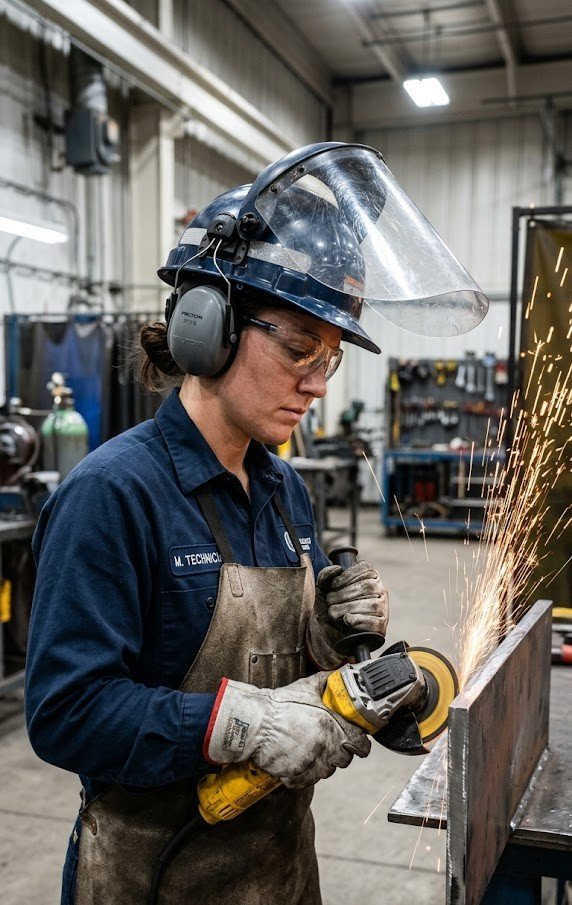
PPE should match the task, the tool, and the hazards present in the work area. Employees using hand and power tools who are exposed to falling, flying, abrasive, and splashing objects, or to harmful dusts, fumes, mists, vapors, or gases, must be provided the PPE needed to protect them from the hazard (29 CFR 1926.300(c); 1910.132(a)).
- Wear eye or face protection against flying particles and debris from grinders and saws (1910.133(a); 1926.102(a)). Protective eye and face devices must meet the ANSI Z87.1 requirements the rules reference (1910.133(b); 1926.102(b)). More about the standards: American National Standards Institute (ANSI).
- Select hand protection based on the hazards and the task (1910.138). Around rotating equipment, avoid gloves or clothing that can be caught, which is general safety advice rather than rule text.
- Hearing protectors must be made available at no cost to employees exposed to an 8-hour time-weighted average of 85 decibels or greater in general industry (1910.95(i)(1)). Construction noise limits are in 1926.52. NIOSH shares guidance on occupational noise: NIOSH noise.
- Wear protective footwear where there is a danger of foot injury from falling or rolling objects or objects piercing the sole (1910.136(a)). In construction, 1926.96 requires safety-toe footwear to meet the ANSI Z41.1 specification it references.
- Defective or damaged PPE must not be used (1910.132(e)). Check PPE before each use.

Building a Preventive Tool Maintenance Program That Improves Workplace Safety
Employers are responsible for the safe condition of tools and equipment, including tools furnished by employees (29 CFR 1910.242(a); 1926.300(a)). A routine inspection and maintenance habit helps catch problems early.
- Check portable electric tools, grinders, compressed air equipment, and cutting tools before use, for damaged cords, loose or missing guards, cracked or worn wheels and blades, and damaged hoses or fittings. A written inspection schedule is good practice and is not required by those sections.
- Remove damaged or defective equipment from service until it is repaired or replaced, and tag it so no one uses it (tagging is general good practice, not required by those sections). Cracked saws must be removed from service (1910.243(a)(4); 1910.213(s)(7)).
- The manufacturer’s safe operating pressure for hoses, pipes, valves, filters, and other fittings must not be exceeded (1926.302(b)(5)). Keeping manufacturer instructions available and following them for operation and maintenance is general good practice.
- Watch for warning signs such as unusual vibration, overheating, worn blades, damaged cords, air leaks, loose guards, or abnormal noises.
- Learn more about equipment safety and injury prevention from the National Safety Council (NSC).

Download the Portable Tool and Equipment Safety Overview PDF
Download the printable Portable Tool and Equipment Safety overview. It lists the topics in this section and includes a sign-in sheet that records attendance only. It is a discussion aid and does not replace training, tool inspections, or the requirements that OSHA and your employer set.
A short hand and power tool safety toolbox talk for today's task
Choose a tool the crew will actually use. This discussion covers preparation, damage checks and stopping unsafe use. It does not replace the tool’s instructions, required training or a task-specific hazard assessment. The existing topic overview PDF remains available above.
1. Match the tool and accessory to the task
Identify the material, work area and energy source. Follow the manufacturer’s instructions for compatible accessories, guards and operating limits. Plan how the workpiece will be supported or secured, how bystanders will be kept clear, and how dust, noise, sparks and flying debris will be controlled. Do not treat PPE as a substitute for required guards or other controls.
2. Inspect before starting
Look for damaged cords or plugs, loose parts, missing guards and worn or damaged accessories. Check the items the manufacturer specifies for this tool. Do not energize a suspect tool to see if it still works. In general industry, 29 CFR 1910.334(a)(2) requires visual inspection of portable cord-and-plug equipment and extension cords before use on any shift, with a limited exception for connected equipment not exposed to damage until it is relocated. Construction rules in 1926.300(a) require hand and power tools to be maintained in a safe condition.
3. Disconnect before changing accessories
OSHA’s hand-and-power-tool guidance says to disconnect tools when not in use, before servicing or cleaning, and before changing accessories such as blades, bits and cutters. Use the manufacturer’s safe disconnection steps for the tool’s energy source and follow applicable employer energy-control procedures. Do not rely on the trigger being released or a switch being off.
4. Remove, report and arrange a safe replacement
If damage or a missing safety feature makes a tool unsafe, stop using it. Remove it from service and report it through the employer’s process. OSHA’s tool guidance recommends tagging damaged portable electric tools “Do Not Use.” In general industry, damaged cord-and-plug equipment covered by 1910.334(a)(2)(ii) may not be used until the repairs and tests needed to make it safe have been completed. Do not bypass a guard, improvise a repair or hand the tool to the next worker.
Ask the crew
- Which tool and accessory will we use, and where are the instructions?
- What defect would make us stop and remove this tool from service?
- Who receives the defect report, where is unsafe equipment kept, and how will we get a suitable replacement?
Record the tool, defect or hazard, agreed action, responsible person and recheck using the toolbox talk template and sign-in sheet. A signature records attendance only, not competence or completion of required training.
Sources and scope
29 CFR 1910.334 covers general-industry use of electrical equipment. 29 CFR 1926.300 covers construction hand and power tools. OSHA Hand and Power Tools supplies practical precautions; it is guidance rather than the current rule text. Specific tool types and work settings have additional requirements.
General safety information only. Verify current requirements with OSHA and your employer. Follow applicable regulations, equipment manufacturers’ instructions and employer procedures. This discussion does not replace required training, a site-specific hazard assessment or qualified advice.
Frequently Asked Questions About Portable Tool Safety PDF for Safer Jobsites
Get clear answers about toolbox talks, safety topics, and training resources.
A Portable Tool and Equipment Safety toolbox talk is a short meeting that reviews how to use, inspect, guard, and maintain hand and power tools. Employers are responsible for the safe condition of tools and equipment (29 CFR 1910.242(a); 1926.300(a)). A toolbox talk does not replace required training or the manufacturer’s instructions.
Check cords, switches, guards, handles, blades, abrasive wheels, hoses, and fittings before use. Portable circular saws need the upper and lower guards, hand-held power tools need the required switches, abrasive wheels need to be inspected and ring tested before mounting, and cracked saws must be removed from service (29 CFR 1910.243(a)(1), (a)(4); 1910.215(d)(1); 1926.300(d)). Remove damaged equipment from service.
Any workplace that uses hand-held or powered tools needs to follow the rules for guarding, switches, grounding, and PPE. General industry tool rules are in 29 CFR 1910 Subpart P and Subpart O, and construction rules are in 29 CFR 1926 Subpart I.
Reviewing portable tool safety before new equipment is introduced, before high-risk tasks, and when new employees start are common ways to use a toolbox talk. The rules on this page set the requirements for guarding, switches, and PPE, and training and tool inspections required by OSHA or your employer still apply.
The rules on this page cover guards on tools and wheels, required switches and controls, compressed air for cleaning (only below 30 p.s.i. and with chip guarding and PPE), and the PPE needed for flying particles and other tool hazards (29 CFR 1910.243; 1910.242(b); 1926.300; 1926.302).