
Free Handling and Storage Toolbox Talk Training | Safe Lifting and Workplace Safety Topics
A short material handling toolbox talk for today’s job
Print this discussion: Download the one-page material handling toolbox talk (PDF). Includes crew questions and space to record the task, hazards and actions. The original topic overview PDF remains available.
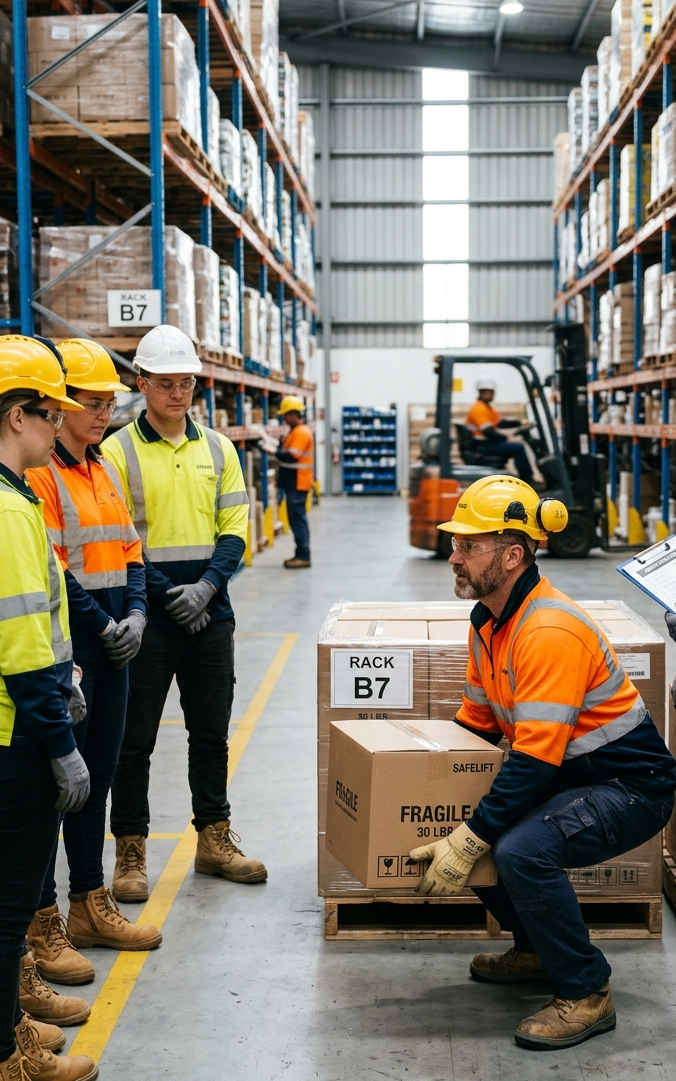
Use these prompts for a discussion before moving or storing materials. The focus is manual handling, clear travel routes and stable storage. Crane, rigging and powered-truck tasks need their own task-specific procedures and required training.
1. Plan the move before touching the load
Identify the load, where it is going and how it will get there. Discuss its size, grip, stability and the route. Look for awkward reaches, repeated lifts and carrying distances. Can you reduce manual handling by changing the layout or using suitable handling equipment? OSHA’s warehouse guidance recommends reducing bending and reaching and using equipment or work design to reduce strain.
2. Check the route and the landing area
Keep aisles and passageways clear and in good repair. Where mechanical handling equipment operates, allow sufficient safe clearance at doors, turns and loading docks. Before starting, point out pedestrian routes, obstructions and where the load will be set down. Do not start a move with an obstructed route.
3. Keep stored materials stable
Stored materials must not create a hazard. Secure tiered materials against sliding or collapse. Check the condition of racks and shelves, and do not exceed their load capacities. Report damaged racking and isolate the affected area. In construction, stored loads must also stay within the maximum safe load limits of floors.
4. Stop when the plan no longer fits
If the load shifts, the route becomes blocked or the storage arrangement looks unstable, stop and get the supervisor to review the plan. Do not improvise a lift or try to catch falling materials. Identify the handling aid, people and controls needed before restarting.
For a focused follow-on discussion about avoiding awkward lifts, use our manual handling planning exercise. Choose a real load, compare handling methods and record who will check the change.
Ask the crew
- What is the most difficult load we will move today, and can we avoid lifting it manually?
- Where could someone be struck, trapped or exposed to a falling load?
- Which route and storage area will we use, and who will correct any hazards before the move?
Record the task, hazards discussed and follow-up actions using our free toolbox talk template and sign-in sheet. A signature records attendance; it is not proof of competence or completion of required training.
Sources and scope
General industry storage and aisle requirements: 29 CFR 1910.176. Construction storage requirements: 29 CFR 1926.250. Practical warehouse ergonomics and storage guidance: OSHA Warehousing: Hazards and Solutions. These sources apply to different work settings; check the rules for your operation.
General safety information only. This discussion aid does not replace required training, a site-specific hazard assessment, employer procedures or qualified advice. Review current requirements before use.
Existing topic descriptions
Safe Sling Lifting Toolbox Talk: Best Practices for Material Handling and Rigging Safety
Before each use, a competent person designated by the employer must inspect the sling and all fastenings and attachments for damage or defects, and damaged or defective slings must be removed from service immediately. Slings may not be loaded beyond their rated capacity, shortened with knots or bolts, kinked, used without legible identification markings, or shock loaded. Pad slings against sharp edges and keep employees clear of loads about to be lifted and of suspended loads (29 CFR 1910.184(c)-(d); 1926.251(a), (c)).
Sling Rigging Methods Toolbox Talk: How Different Rigging Configurations Affect Load Capacity
A vertical hitch uses one leg of the sling. A choker hitch passes one end through the fitting on the other end. In a basket hitch the sling passes under the load with both ends on the hook or master link, and the load must be balanced to prevent slippage. Wire rope, fiber rope, and web slings must be marked with the rated capacity for the type of hitch used, so use the marked capacity for the hitch you are actually rigging (29 CFR 1910.184(b), (c)(5), (f)(1), (h)(1), (i)(1); 1926.251(c)(8), (c)(16), (e)(1)).
Sling Angle Safety Toolbox Talk: How Sling Angles Impact Lifting Capacity
The angle of loading is the inclination of a sling leg from the horizontal or vertical (29 CFR 1910.184(b)). In general industry, wire rope slings and natural and synthetic fiber rope slings must be marked with the angle on which the rated capacity is based (1910.184(f)(1), (h)(1)). In construction, wire rope slings must carry that marking (1926.251(c)(16)). As a general rule, the lower a sling leg sits above horizontal, the more tension that leg carries for the same load, so check the manufacturer’s rating for the angle you will use. Never load a sling beyond its rated capacity (1910.184(c)(4); 1926.251(a)(2)(ii)).
Wire Rope Sling Inspection Toolbox Talk: Identifying Damage Before Every Lift
A competent person designated by the employer must inspect the sling each day before use (29 CFR 1910.184(d); 1926.251(a)(6)). General industry rules require immediate removal of a wire rope sling for ten randomly distributed broken wires in one rope lay or five broken wires in one strand in one rope lay; wear or scraping of one-third the original diameter of outside wires; kinking, crushing, bird caging, or other distortion; heat damage; cracked, deformed, or worn end attachments; hooks opened more than 15 percent of the throat opening or twisted more than 10 degrees; or corrosion (1910.184(f)(5)). Construction rules say wire rope may not be used if, in any length of eight diameters, visible broken wires exceed 10 percent of the total, or if it shows other signs of excessive wear, corrosion, or defect (1926.251(c)(4)(iv)).
Alloy Steel Chain Sling Inspection Toolbox Talk: Preventing Lifting Equipment Failures
In addition to the daily inspection, alloy steel chain slings need a thorough periodic inspection at intervals set by how often and how severely they are used, and never more than 12 months apart. The employer must keep a record of the most recent month in which each sling was thoroughly inspected. In general industry the inspection is done by a competent person and covers wear, defective welds, deformation, and increase in length, and a sling with these defects is removed from service immediately (29 CFR 1910.184(e)(3)). Also in general industry, remove the chain if its size at any point of a link is below the minimum in Table N-184-1, and remove slings with cracked or deformed master links, coupling links, or other components (1910.184(e)(8)-(9)). In construction, the assembly must be removed from service whenever wear at any point of any chain link exceeds the limits in Table H-1 (1926.251(b)(5)), and the same 12-month periodic inspection and monthly record apply (1926.251(b)(6)). Makeshift links or fasteners made from bolts or rods may not be used (1910.184(e)(2)(ii); 1926.251(b)(3)).
Synthetic Web Sling Inspection Toolbox Talk: Preventing Wear, Cuts, and Lifting Hazards
Remove a synthetic web sling from service immediately for acid or caustic burns; melting or charring of any part of the sling surface; snags, punctures, tears, or cuts; broken or worn stitches; or distortion of fittings (29 CFR 1910.184(i)(9); 1926.251(e)(8)). Nylon web slings may not be used where fumes, vapors, sprays, mists, or liquids of acids or phenolics are present. Polyester and polypropylene web slings may not be used where caustics are present. Polyester and nylon web slings may not be used above 180 °F, and polypropylene above 200 °F (1910.184(i)(6)-(7); 1926.251(e)(6)-(7)).
Overhead Crane and Hoist Inspection Toolbox Talk: Safe Equipment Checks Before Every Lift
For overhead and gantry cranes, OSHA requires frequent inspections at daily to monthly intervals and periodic inspections at 1 to 12 month intervals. Daily items include operating mechanisms and air or hydraulic lines. Hooks and hoist chains get a visual inspection daily and a monthly inspection with a signed certification record. A crane idle for a month or more must be inspected before it is placed back in service (29 CFR 1910.179(j)(1)-(4)). Crane operators and riggers must also follow the manufacturer’s instructions and your employer’s procedures.
Mobile Crane Safety Toolbox Talk: Protecting Workers During Crane Operations
On construction sites covered by 29 CFR 1926 Subpart CC, a competent person must visually inspect a crane before each shift (1926.1412(d)). Where the rotating superstructure could strike or pinch employees, employers must mark the swing hazard areas with control lines, warning lines, railings, or similar barriers and train employees to recognize them (1926.1424(a)). While the operator is not moving a suspended load, no employee may be in the fall zone except employees hooking, unhooking, or guiding a load, making the initial attachment of a load to a component or structure, or operating a concrete hopper or bucket. Employees hooking, unhooking, or guiding a load or making the initial connection must meet the conditions of 1926.1425(c): the load rigged to prevent unintentional displacement, hooks with self-closing latches or equivalent, and a qualified rigger (1926.1425(b)-(c)). A signal person is required when the point of operation is not in full view of the operator, when the view in the direction of travel is obstructed, or when site conditions make one necessary (1926.1419(a)).
Forklift and Powered Industrial Truck Safety Toolbox Talk: Preventing Material Handling Accidents
General industry rules for powered industrial trucks are in 29 CFR 1910.178. Only operators who have completed the required training and evaluation may operate a truck (1910.178(l)). Trucks must be examined before being placed in service, at least daily, or after each shift when used around the clock, and a truck that is unsafe must be taken out of service (1910.178(q)(7), (p)(1)). No one may stand or pass under the elevated portion of a truck, loaded or empty (1910.178(m)(2)). Only stable or safely arranged loads within the truck’s rated capacity may be handled (1910.178(o)(1)-(2)). Drivers must slow down and sound the horn at cross aisles and where vision is obstructed (1910.178(n)(4)). For construction, 1926.602(d) addresses powered industrial truck operator training only; it states that the construction requirements are identical to those in 1910.178(l).
Palletized Material Safety Toolbox Talk: Safe Storage, Stacking, and Material Handling
Storage of material must not create a hazard. Bags, containers, bundles, and similar items stored in tiers must be stacked, blocked, interlocked, and limited in height so they are stable and secure against sliding or collapse (29 CFR 1910.176(b)). In construction, materials stored in tiers must be stacked, racked, blocked, interlocked, or otherwise secured to prevent sliding, falling, or collapse (1926.250(a)(1)). Aisles and passageways must be kept clear and in good repair (1910.176(a); 1926.250(a)(3)).
Storage Rack and Shelving Safety Toolbox Talk: Preventing Collapses and Falling Objects
Material stored on racks and shelves must not create a hazard and must be stable and secure against sliding or collapse (29 CFR 1910.176(b); 1926.250(a)(1)). In construction, the weight of stored materials on floors within buildings and structures may not exceed maximum safe load limits, which must be posted in pounds per square foot in storage areas except on a floor or slab on grade (1926.250(a)(2)). Storage areas must be kept free of accumulations that create tripping, fire, explosion, or pest hazards (1910.176(c); 1926.250(c)). Follow the rack or shelving manufacturer’s load ratings, and report damaged or overloaded racks to your supervisor.
Safe Lifting Techniques Toolbox Talk: Proper Manual Material Handling to Prevent Injuries
OSHA has no federal standard that sets a maximum weight for manual lifting. Employers must still keep the workplace free of recognized serious hazards, including ergonomic hazards (OSH Act General Duty Clause, Section 5(a)(1)). NIOSH’s revised lifting equation starts from a 51 lb load constant for ideal lifting conditions and lowers the recommended weight as the load is held farther from the body, lifted higher or lower, twisted, lifted more often, or gripped poorly. Plan each lift, keep the load close, avoid twisting, and use team lifts or mechanical equipment for heavy or awkward loads.

Material Handling and Storage Toolbox Safety Talks
Safe Sling Lifting Toolbox Talk: Best Practices for Material Handling and Rigging Safety
Before each use, a competent person designated by the employer must inspect the sling and all fastenings and attachments for damage or defects, and damaged or defective slings must be removed from service immediately. Slings may not be loaded beyond their rated capacity, shortened with knots or bolts, kinked, used without legible identification markings, or shock loaded. Pad slings against sharp edges and keep employees clear of loads about to be lifted and of suspended loads (29 CFR 1910.184(c)-(d); 1926.251(a), (c)).
Sling Rigging Methods Toolbox Talk: How Different Rigging Configurations Affect Load Capacity
A vertical hitch uses one leg of the sling. A choker hitch passes one end through the fitting on the other end. In a basket hitch the sling passes under the load with both ends on the hook or master link, and the load must be balanced to prevent slippage. Wire rope, fiber rope, and web slings must be marked with the rated capacity for the type of hitch used, so use the marked capacity for the hitch you are actually rigging (29 CFR 1910.184(b), (c)(5), (f)(1), (h)(1), (i)(1); 1926.251(c)(8), (c)(16), (e)(1)).
Sling Angle Safety Toolbox Talk: How Sling Angles Impact Lifting Capacity
The angle of loading is the inclination of a sling leg from the horizontal or vertical (29 CFR 1910.184(b)). In general industry, wire rope slings and natural and synthetic fiber rope slings must be marked with the angle on which the rated capacity is based (1910.184(f)(1), (h)(1)). In construction, wire rope slings must carry that marking (1926.251(c)(16)). As a general rule, the lower a sling leg sits above horizontal, the more tension that leg carries for the same load, so check the manufacturer's rating for the angle you will use. Never load a sling beyond its rated capacity (1910.184(c)(4); 1926.251(a)(2)(ii)).
Wire Rope Sling Inspection Toolbox Talk: Identifying Damage Before Every Lift
A competent person designated by the employer must inspect the sling each day before use (29 CFR 1910.184(d); 1926.251(a)(6)). General industry rules require immediate removal of a wire rope sling for ten randomly distributed broken wires in one rope lay or five broken wires in one strand in one rope lay; wear or scraping of one-third the original diameter of outside wires; kinking, crushing, bird caging, or other distortion; heat damage; cracked, deformed, or worn end attachments; hooks opened more than 15 percent of the throat opening or twisted more than 10 degrees; or corrosion (1910.184(f)(5)). Construction rules say wire rope may not be used if, in any length of eight diameters, visible broken wires exceed 10 percent of the total, or if it shows other signs of excessive wear, corrosion, or defect (1926.251(c)(4)(iv)).
Alloy Steel Chain Sling Inspection Toolbox Talk: Preventing Lifting Equipment Failures
In addition to the daily inspection, alloy steel chain slings need a thorough periodic inspection at intervals set by how often and how severely they are used, and never more than 12 months apart. The employer must keep a record of the most recent month in which each sling was thoroughly inspected. In general industry the inspection is done by a competent person and covers wear, defective welds, deformation, and increase in length, and a sling with these defects is removed from service immediately (29 CFR 1910.184(e)(3)). Also in general industry, remove the chain if its size at any point of a link is below the minimum in Table N-184-1, and remove slings with cracked or deformed master links, coupling links, or other components (1910.184(e)(8)-(9)). In construction, the assembly must be removed from service whenever wear at any point of any chain link exceeds the limits in Table H-1 (1926.251(b)(5)), and the same 12-month periodic inspection and monthly record apply (1926.251(b)(6)). Makeshift links or fasteners made from bolts or rods may not be used (1910.184(e)(2)(ii); 1926.251(b)(3)).
Synthetic Web Sling Inspection Toolbox Talk: Preventing Wear, Cuts, and Lifting Hazards
Remove a synthetic web sling from service immediately for acid or caustic burns; melting or charring of any part of the sling surface; snags, punctures, tears, or cuts; broken or worn stitches; or distortion of fittings (29 CFR 1910.184(i)(9); 1926.251(e)(8)). Nylon web slings may not be used where fumes, vapors, sprays, mists, or liquids of acids or phenolics are present. Polyester and polypropylene web slings may not be used where caustics are present. Polyester and nylon web slings may not be used above 180 °F, and polypropylene above 200 °F (1910.184(i)(6)-(7); 1926.251(e)(6)-(7)).
Overhead Crane and Hoist Inspection Toolbox Talk: Safe Equipment Checks Before Every Lift
For overhead and gantry cranes, OSHA requires frequent inspections at daily to monthly intervals and periodic inspections at 1 to 12 month intervals. Daily items include operating mechanisms and air or hydraulic lines. Hooks and hoist chains get a visual inspection daily and a monthly inspection with a signed certification record. A crane idle for a month or more must be inspected before it is placed back in service (29 CFR 1910.179(j)(1)-(4)). Crane operators and riggers must also follow the manufacturer's instructions and your employer's procedures.
Mobile Crane Safety Toolbox Talk: Protecting Workers During Crane Operations
On construction sites covered by 29 CFR 1926 Subpart CC, a competent person must visually inspect a crane before each shift (1926.1412(d)). Where the rotating superstructure could strike or pinch employees, employers must mark the swing hazard areas with control lines, warning lines, railings, or similar barriers and train employees to recognize them (1926.1424(a)). While the operator is not moving a suspended load, no employee may be in the fall zone except employees hooking, unhooking, or guiding a load, making the initial attachment of a load to a component or structure, or operating a concrete hopper or bucket. Employees hooking, unhooking, or guiding a load or making the initial connection must meet the conditions of 1926.1425(c): the load rigged to prevent unintentional displacement, hooks with self-closing latches or equivalent, and a qualified rigger (1926.1425(b)-(c)). A signal person is required when the point of operation is not in full view of the operator, when the view in the direction of travel is obstructed, or when site conditions make one necessary (1926.1419(a)).
Forklift and Powered Industrial Truck Safety Toolbox Talk: Preventing Material Handling Accidents
General industry rules for powered industrial trucks are in 29 CFR 1910.178. Only operators who have completed the required training and evaluation may operate a truck (1910.178(l)). Trucks must be examined before being placed in service, at least daily, or after each shift when used around the clock, and a truck that is unsafe must be taken out of service (1910.178(q)(7), (p)(1)). No one may stand or pass under the elevated portion of a truck, loaded or empty (1910.178(m)(2)). Only stable or safely arranged loads within the truck's rated capacity may be handled (1910.178(o)(1)-(2)). Drivers must slow down and sound the horn at cross aisles and where vision is obstructed (1910.178(n)(4)). For construction, 1926.602(d) addresses powered industrial truck operator training only; it states that the construction requirements are identical to those in 1910.178(l).
Palletized Material Safety Toolbox Talk: Safe Storage, Stacking, and Material Handling
Storage of material must not create a hazard. Bags, containers, bundles, and similar items stored in tiers must be stacked, blocked, interlocked, and limited in height so they are stable and secure against sliding or collapse (29 CFR 1910.176(b)). In construction, materials stored in tiers must be stacked, racked, blocked, interlocked, or otherwise secured to prevent sliding, falling, or collapse (1926.250(a)(1)). Aisles and passageways must be kept clear and in good repair (1910.176(a); 1926.250(a)(3)).
Storage Rack and Shelving Safety Toolbox Talk: Preventing Collapses and Falling Objects
Material stored on racks and shelves must not create a hazard and must be stable and secure against sliding or collapse (29 CFR 1910.176(b); 1926.250(a)(1)). In construction, the weight of stored materials on floors within buildings and structures may not exceed maximum safe load limits, which must be posted in pounds per square foot in storage areas except on a floor or slab on grade (1926.250(a)(2)). Storage areas must be kept free of accumulations that create tripping, fire, explosion, or pest hazards (1910.176(c); 1926.250(c)). Follow the rack or shelving manufacturer's load ratings, and report damaged or overloaded racks to your supervisor.
Safe Lifting Techniques Toolbox Talk: Proper Manual Material Handling to Prevent Injuries
OSHA has no federal standard that sets a maximum weight for manual lifting. Employers must still keep the workplace free of recognized serious hazards, including ergonomic hazards (OSH Act General Duty Clause, Section 5(a)(1)). NIOSH's revised lifting equation starts from a 51 lb load constant for ideal lifting conditions and lowers the recommended weight as the load is held farther from the body, lifted higher or lower, twisted, lifted more often, or gripped poorly. Plan each lift, keep the load close, avoid twisting, and use team lifts or mechanical equipment for heavy or awkward loads.
Material Handling and Storage Toolbox Talk Resources
ToolboxTalk.com provides free material handling resources covering common workplace hazards and safe work practices. If your company provides safety equipment, services or training, explore partnership opportunities with ToolboxTalk.
Why This Material Handling Safety Topic Matters
Proper material handling is about more than simply moving heavy objects. Every lift, transport, storage task, or equipment inspection is a chance to prevent injuries and equipment damage. Safe work starts with workers understanding the hazards and the safe work practices before each task.
- Reduce the risk of struck-by incidents, caught-between hazards, dropped loads, and manual handling injuries by following the lifting, rigging, and storage rules that apply to your work, such as 29 CFR 1910.176, 1910.178, 1910.184, 1926.250, and 1926.251.
- Use the right lifting equipment, safe rigging practices, organized storage, and equipment inspections before work begins.
- Encourage workers to report damaged slings, forklifts, cranes, racks, or lifting devices before they create serious workplace hazards.
- Keep supervisors, operators, riggers, signal persons, and ground workers in clear communication during every lifting operation.
- Learn more about material handling, ergonomics, and injury prevention from the National Institute for Occupational Safety and Health (NIOSH): NIOSH Workplace Safety and Health Topics

Common Material Handling Mistakes That Can Lead to Serious Workplace Injuries
Even experienced workers can develop unsafe habits over time, especially when deadlines, repetitive tasks, or routine work create a false sense of confidence. Reviewing these common mistakes during your toolbox talk helps crews recognize hazards before they result in injuries or equipment damage.
- Skipping pre-use inspections of slings, forklifts, cranes, hoists, racks, or other lifting equipment can allow hidden defects to go unnoticed. Slings must be inspected each day before use, and powered industrial trucks at least daily.
- Loading equipment beyond its rated capacity. Slings, cranes, forklifts, and other lifting equipment must not be loaded beyond their rated capacity (for example 29 CFR 1910.184(c)(4) and 1910.178(o)(2)).
- Ignoring proper communication during lifting operations increases the likelihood of collisions, swinging loads, and struck-by incidents. The Center for Construction Research and Training (CPWR) shares research and guidance on reducing construction-related hazards.
- Failing to keep aisles, loading areas, and storage zones organized creates trip hazards and makes material handling more difficult. Aisles and passageways must be kept clear, and storage areas must be free of tripping, fire, and explosion hazards (29 CFR 1910.176(a), (c); 1926.250(a)(3), (c)).
Get the Printable Material Handling Safety Meeting PDF
Download the printable Material Handling and Storage overview. It lists the topics in this section and includes a sign-in sheet that records attendance only. It is a discussion aid and does not replace the training, inspections, and requirements that OSHA and your employer set.
Frequently Asked Questions About Material Handling Toolbox Talk
Get clear answers about toolbox talks, safety topics, and training resources.
Material handling is the process of moving, lifting, storing, and protecting materials in a workplace, by hand or with equipment such as slings, cranes, hoists, and forklifts. Material handling safety helps prevent lifting injuries, dropped loads, and struck-by and crushing hazards in construction, manufacturing, warehousing, and industrial facilities. A toolbox talk helps crews review the hazards before a task starts.
Common material handling hazards include awkward or repetitive manual lifting, overloaded or damaged slings, unstable or poorly stacked loads, falling materials, forklift and powered industrial truck incidents, struck-by and caught-between hazards around cranes and suspended loads, pinch points, poor storage practices, and cluttered aisles. Identifying these hazards before work starts lets workers take corrective action.
Plan each lift, keep the load close to the body, avoid twisting, and use team lifts or mechanical equipment for heavy or awkward loads. OSHA has no federal standard that sets a maximum weight for manual lifting, but employers must keep the workplace free of recognized serious hazards, including ergonomic hazards. NIOSH’s revised lifting equation lowers the recommended weight as the load is held farther from the body, lifted higher or lower, twisted, or lifted more often.
Inspections find damage before it causes a failure. A competent person designated by the employer must inspect slings and all fastenings and attachments each day before use (29 CFR 1910.184(d); 1926.251(a)(6)). In general industry, powered industrial trucks must be examined at least daily before being placed in service, or after each shift if used around the clock (1910.178(q)(7)). Cranes have their own inspection schedules, such as shift, monthly, and annual inspections under 1926.1412 for construction cranes and frequent and periodic inspections under 1910.179(j) for overhead cranes. Damaged or defective equipment must be removed from service.
Regular toolbox talks give crews a chance to review current hazards, safe lifting practices, and equipment checks, and to raise safety concerns. A toolbox talk does not replace the training, inspections, and requirements that OSHA and your employer set. For example, powered industrial truck operators must complete the training and evaluation required by 29 CFR 1910.178(l), and crane signal persons must meet the qualification requirements of 1926.1428 on construction sites.